Basic Algebra Formulas Every Student Should Know
Algebra trips students up mostly because of one reason: they try to memorize formulas without understanding what each one actually does. Once you know what a formula is for and see it applied to a real number, it sticks.
This guide covers the core basic algebra formulas used in school math, from identity rules and exponent laws to linear and quadratic equations. Each one includes a plain-English explanation and a worked example so you can follow the logic, not just copy the formula. You can also check your results instantly using the free online scientific calculator on CalcSolver.
What Are Basic Algebra Formulas?
Basic algebra formulas are fixed mathematical rules that let you expand, simplify, or solve expressions and equations without working through every step from scratch. They cover patterns that repeat across almost every type of algebra problem.
Knowing these formulas saves time on tests and helps you check your work faster. They show up in homework, competitive exams, and higher-level math topics like calculus and statistics, so building a solid grip on them early pays off.
Algebraic Identity Formulas
Identity formulas are used to expand or factor expressions involving two terms. These come up constantly in school algebra.
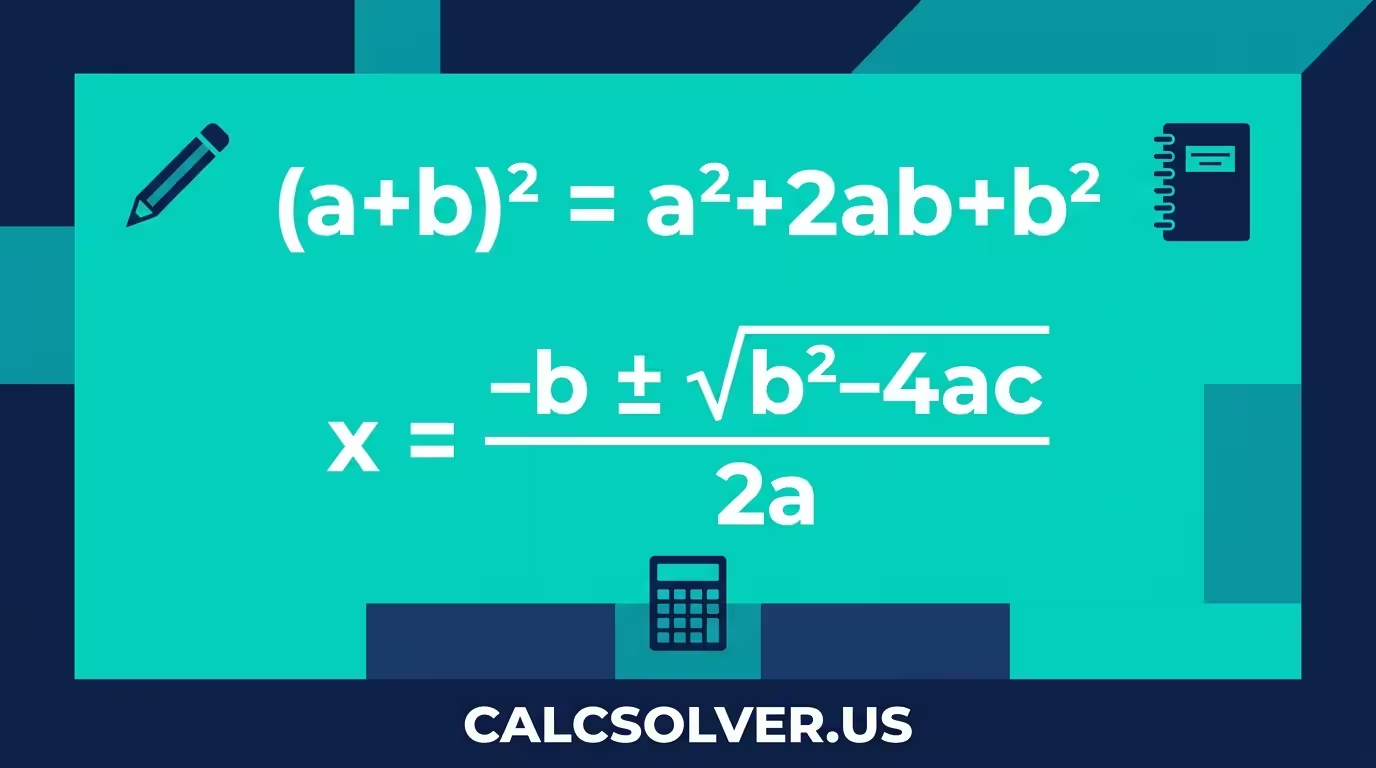
(a + b)² = a² + 2ab + b²
This expands a squared binomial. Example: (x + 3)² = x² + 6x + 9
(a − b)² = a² − 2ab + b²
Same pattern with subtraction. Example: (x − 4)² = x² − 8x + 16
(a + b)(a − b) = a² − b²
This is the difference of squares. Example: (x + 5)(x − 5) = x² − 25
(a + b)³ = a³ + 3a²b + 3ab² + b³
Used to expand a cubed binomial. Example: (x + 2)³ = x³ + 6x² + 12x + 8
(a − b)³ = a³ − 3a²b + 3ab² − b³
Same structure, signs alternate. Example: (x − 1)³ = x³ − 3x² + 3x − 1
The most common mistake students make is dropping the middle term. In (a + b)², the 2ab term is almost always forgotten. Write it out every time until it becomes automatic.
Distributive, Commutative, and Associative Properties
These three rules apply at every level of algebra. They are not just formulas — they explain why algebraic manipulation is valid.
Distributive Law: a(b + c) = ab + ac
This removes brackets by multiplying the term outside with each term inside.
Example: 5(x + 3) = 5x + 15
Use this whenever you see a number or variable touching a bracket. It is one of the first moves in simplifying any expression.
Commutative Property: a + b = b + a and a × b = b × a
Order does not change the result for addition and multiplication.
Example: 4 + 7 = 7 + 4 and 3 × 8 = 8 × 3
This property does not apply to subtraction or division, which students frequently forget.
Associative Property: (a + b) + c = a + (b + c)
Grouping does not change the result for addition and multiplication.
Example: (2 + 3) + 4 = 2 + (3 + 4) = 9
These properties form the logical foundation behind every algebraic step you take when rearranging an equation.
Exponent Rules
Exponent rules, also called laws of indices, come up any time you work with powers. These are essential for simplifying expressions quickly.
aᵐ × aⁿ = aᵐ⁺ⁿ — Multiply same base: add the exponents. Example: x³ × x⁴ = x⁷
aᵐ ÷ aⁿ = aᵐ⁻ⁿ — Divide same base: subtract the exponents. Example: x⁶ ÷ x² = x⁴
(aᵐ)ⁿ = aᵐⁿ — Power of a power: multiply the exponents. Example: (x²)³ = x⁶
a⁰ = 1 (where a ≠ 0) — Any non-zero number raised to the power of zero equals 1. Example: 7⁰ = 1
Students frequently apply these rules across different bases, which is incorrect. x³ × y³ cannot be combined using the product rule because the bases are different.
Linear Equation Formula
A linear equation in one variable has the standard form:
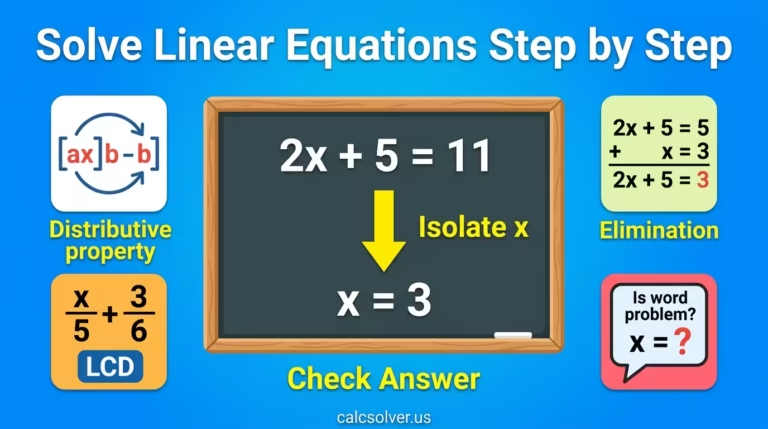
ax + b = 0
To solve for x, isolate the variable:
x = −b / a
Example: Solve 3x + 9 = 0
x = −9 / 3 = −3
Linear equations are the most common type you will see in early algebra. Every step in solving them uses the properties from the previous section — moving terms across the equals sign by applying inverses.
Quadratic Formula
For equations of the form ax² + bx + c = 0, the quadratic formula gives both solutions directly:
x = (−b ± √(b² − 4ac)) / 2a
The expression inside the square root, b² − 4ac, is called the discriminant. It tells you what kind of solutions to expect:
- If b² − 4ac is greater than 0, there are two real solutions.
- If b² − 4ac equals 0, there is exactly one real solution.
- If b² − 4ac is less than 0, there are no real solutions (complex roots only).
Example: Solve x² + 5x + 6 = 0
Here a = 1, b = 5, c = 6
x = (−5 ± √(25 − 24)) / 2 = (−5 ± 1) / 2
x = −2 or x = −3
The quadratic formula always works, regardless of whether the equation factors easily or not. Many students try to factor first, which is fine, but the formula is your guaranteed fallback.
Quick Reference Table
| Formula | Use Case |
|---|---|
| (a + b)² = a² + 2ab + b² | Expand squared binomial |
| (a + b)(a − b) = a² − b² | Difference of squares |
| a(b + c) = ab + ac | Remove brackets |
| aᵐ × aⁿ = aᵐ⁺ⁿ | Multiply same-base powers |
| x = −b / a | Solve linear equation |
| x = (−b ± √(b² − 4ac)) / 2a | Solve quadratic equation |
Frequently Asked Questions
What are the most important basic algebra formulas?
The most used are the square identity (a + b)², the difference of squares (a + b)(a − b), the distributive law, exponent product and power rules, the linear equation formula x = −b/a, and the quadratic formula. These cover the vast majority of school algebra problems.
What is the difference between an algebraic identity and a formula?
An algebraic identity is true for all values of the variables, like (a + b)² = a² + 2ab + b². A formula is a fixed rule used to calculate a specific result, like x = −b/a for a linear equation. Both are used in algebra, but identities hold universally while formulas apply to specific problem types.
How do I know when to use the quadratic formula?
Use the quadratic formula when you have an equation in the form ax² + bx + c = 0 and it does not factor easily. It works in all cases and gives exact answers, including when the discriminant is negative and roots are complex.
Why does a⁰ = 1?
Because of the division rule for exponents: aⁿ ÷ aⁿ = aⁿ⁻ⁿ = a⁰, and any number divided by itself equals 1. So a⁰ must equal 1, as long as a is not zero.
What is the distributive property used for in algebra?
The distributive property removes brackets from expressions like 4(x + 5) to give 4x + 20. It is one of the most frequently used steps in simplifying expressions, solving equations, and expanding polynomials.
Algebra builds on itself. Each formula in this guide connects to something bigger. The distributive law feeds into polynomial expansion. Exponent rules feed into scientific notation and logarithms. The quadratic formula opens the door to understanding graphs, roots, and eventually calculus. Getting these right at the foundation level makes every topic after this easier to handle.