1/8 as a Decimal and Percent: Exact Value, Steps, and Real Examples
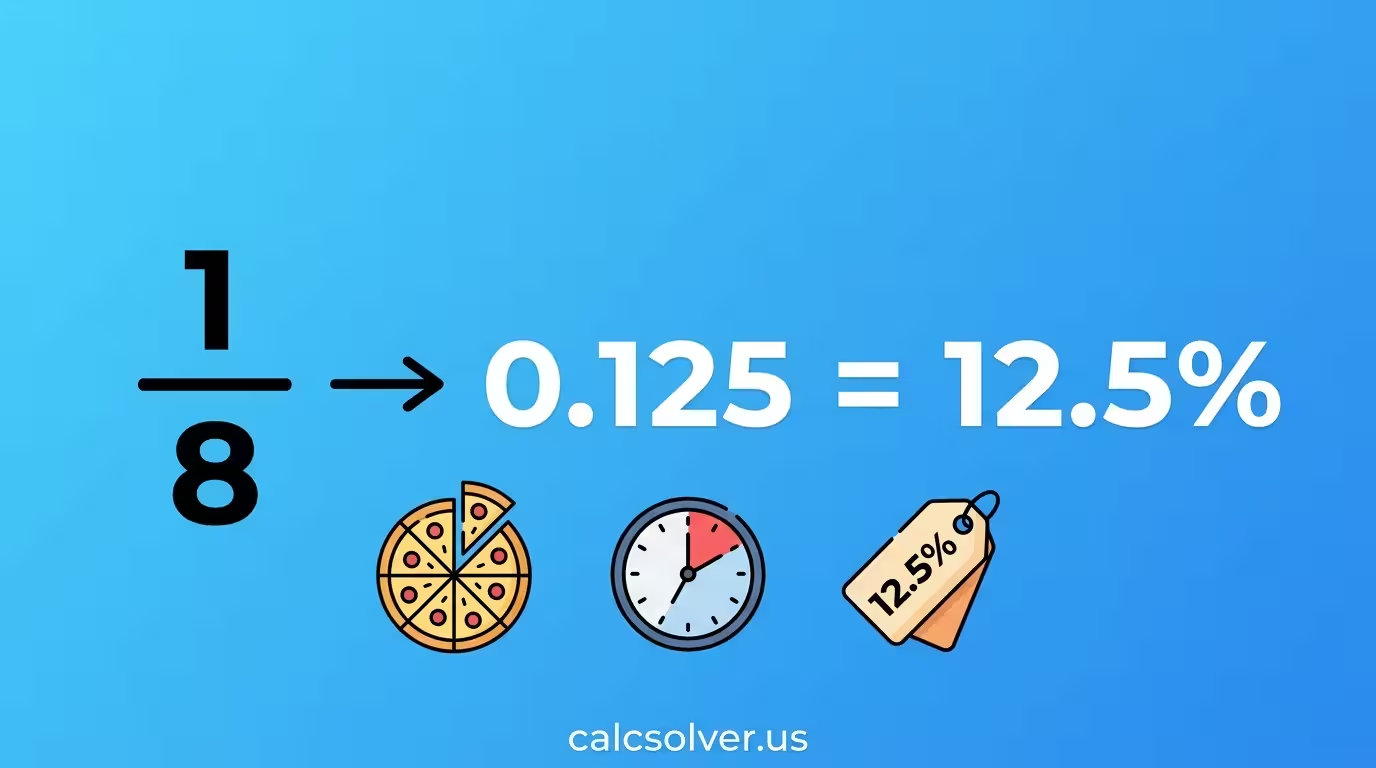
If you need the quick answer: 1/8 as a decimal is 0.125, and as a percent is 12.5%. If you want to understand exactly how to get there and why it works, this guide walks through three methods with real examples. These conversions come up more often than you’d think, from splitting a recipe to reading a discount label. For a broader look at the math behind fractions, visit Basic Algebra Formulas with Examples.
What Does 1/8 Mean?
The fraction 1/8 means one part taken out of eight equal parts of a whole. The number on top (1) is the numerator, which tells you how many parts you have. The number on bottom (8) is the denominator, which tells you how many parts make up the whole. You can explore more fraction and math tools on CalcSolver.
Picture a chocolate bar broken into 8 equal squares. If you take one square, you have taken 1/8 of the bar.
How to Convert 1/8 to a Decimal
To convert any fraction to a decimal, divide the numerator by the denominator. That’s it.
1 divided by 8 = 0.125
Here is how the long division works step by step:
| Step | Operation | Result |
|---|---|---|
| 1 | Write as division: 1 ÷ 8 | Cannot divide directly, so use 10 ÷ 8 |
| 2 | 10 ÷ 8 = 1 remainder 2 | Write 0.1, carry the 2 |
| 3 | 20 ÷ 8 = 2 remainder 4 | Write 0.12, carry the 4 |
| 4 | 40 ÷ 8 = 5 remainder 0 | Write 0.125, done |
1/8 as a decimal = 0.125
This is a terminating decimal, meaning it ends cleanly at three decimal places with no repeating digits.
How to Convert 1/8 to a Percent
Once you have the decimal, converting to percent takes one step: multiply by 100.
0.125 x 100 = 12.5%
Moving the decimal point two places to the right gives you the same result: 0.125 becomes 12.5.
1/8 as a percent = 12.5%
Method 2: Convert Directly from Fraction to Percent
You can skip the decimal step entirely by multiplying the fraction directly by 100.
(1/8) x 100 = 100/8 = 12.5%
Both methods give the same answer. Use whichever feels more natural to you.
Method 3: Scale the Denominator to 1000
Another approach some students find easier is to find an equivalent fraction with 1000 as the denominator, since percent works in hundreds and this makes the math visual.
1/8 = 125/1000
125/1000 means 125 thousandths, which as a decimal is 0.125. Multiply by 100 to get 12.5%.
This method is particularly useful when teaching fractions visually because 125/1000 makes the relationship to the decimal immediately clear.
Summary Table: 1/8 in All Three Forms
| Fraction | Decimal | Percent |
|---|---|---|
| 1/8 | 0.125 | 12.5% |
Eighth Fractions Comparison Table
It helps to see where 1/8 sits among other eighths. Here is the full set:
| Fraction | Decimal | Percent |
|---|---|---|
| 1/8 | 0.125 | 12.5% |
| 2/8 (= 1/4) | 0.250 | 25.0% |
| 3/8 | 0.375 | 37.5% |
| 4/8 (= 1/2) | 0.500 | 50.0% |
| 5/8 | 0.625 | 62.5% |
| 6/8 (= 3/4) | 0.750 | 75.0% |
| 7/8 | 0.875 | 87.5% |
| 8/8 (= 1) | 1.000 | 100.0% |
Notice that every eighth fraction produces a decimal that ends cleanly (no repeating digits) because 8 is a factor of 1000.
Real-Life Uses of 1/8 as a Decimal and Percent
Cooking and Recipes
A recipe calls for 1/8 teaspoon of salt. In decimal form, that is 0.125 teaspoons. If you are scaling the recipe to make eight times the amount, you need exactly 1 teaspoon. If you need to know what percentage of a full teaspoon you are using, the answer is 12.5%.
Time and Scheduling
1/8 of one hour equals 60 x 0.125 = 7.5 minutes. This comes up when breaking work sessions into equal parts or when reading timetables that use fractions of hours.
Shopping and Discounts
A 1/8 discount means you are saving 12.5% of the original price. If something costs $80, your saving is 80 x 0.125 = $10, and you pay $70.
Financial Calculations
Dividing a budget into eighths gives you 12.5% allocations. If your monthly budget is $2,400 and you split it into eight equal categories, each category gets $300.
Construction and Measurements
Tape measures in the US use fractions. 1/8 of an inch is 0.125 inches. Knowing the decimal equivalent speeds up calculations when working with dimensions in both fractional and metric form.
Common Mistakes When Converting Fractions
Dividing the Denominator by the Numerator
Always divide the top number by the bottom number, not the reverse. 8 ÷ 1 = 8, which is completely wrong. The correct calculation is 1 ÷ 8 = 0.125.
Forgetting to Multiply by 100
After you convert a fraction to a decimal, you must multiply by 100 to get the percentage. Stopping at 0.125 and writing that as the percentage is a common error in homework and exams.
Confusing 1/8 the Fraction with 1/8%
These are two different things. 1/8 as a percent = 12.5%. But 1/8% as a decimal = 0.00125 (because you divide 12.5 by 100, then divide again). Make sure you understand which form the question is asking for.
Why 0.125 Has Three Decimal Places
A fraction converts to a terminating decimal when the denominator’s only prime factors are 2 and 5, because those are the prime factors of 10. Since 8 = 2 x 2 x 2, it qualifies. That is why 1/8 gives you a clean, exact decimal with no repeating block.
Fractions like 1/3 do not terminate because 3 is not a factor of any power of 10, which is why 1/3 = 0.3333… (repeating).
Quick Reference: 1/8 Conversion Facts
| Question | Answer |
|---|---|
| What is 1/8 as a decimal? | 0.125 |
| What is 1/8 as a percent? | 12.5% |
| What is 1/8 of 100? | 12.5 |
| What is 1/8 of 1 hour? | 7.5 minutes |
| What is 1/8 of $80? | $10 |
| Is 0.125 a terminating decimal? | Yes |
Frequently Asked Questions
What is 1/8 as a decimal?
1/8 as a decimal is 0.125. You get this by dividing the numerator (1) by the denominator (8): 1 ÷ 8 = 0.125.
What is 1/8 as a percent?
1/8 as a percent is 12.5%. Multiply the decimal form (0.125) by 100 to get the percentage.
Is 1/8 the same as 12.5%?
Yes. The fraction 1/8, the decimal 0.125, and the percentage 12.5% all represent the same value. They are just different ways of writing the same number.
How do you convert 1/8 to a decimal without a calculator?
Divide 1 by 8 using long division. 8 goes into 10 once (remainder 2), into 20 twice (remainder 4), and into 40 exactly 5 times. That gives you 0.125 with no remainder.
What is 1/8 of 1 hour in minutes?
1/8 of 60 minutes = 60 x 0.125 = 7.5 minutes.
What fraction equals 12.5%?
12.5% equals 1/8. You can verify this by dividing 12.5 by 100 to get 0.125, then recognizing that 0.125 = 125/1000 = 1/8.
Understanding fraction-to-decimal and decimal-to-percent conversions is one of the most practical math skills you can build. Once you know that 1/8 = 0.125 = 12.5%, you start noticing it in recipes, price tags, timesheets, and measurement tools. To strengthen your foundation in the math behind these conversions, the Basic Algebra Formulas reference on this site is a good next stop.