Algebraic Expressions: Types, Operations, and Solved Examples Explained
An algebraic expression is a mathematical phrase built from numbers, variables, and operations such as addition, subtraction, multiplication, and division. It does not contain an equals sign, which is what separates it from an equation. For example, 3x + 5 is an expression, while 3x + 5 = 11 is an equation. If you want a quick reference for the formulas that go along with these expressions, the free math solver tools on this site are a good starting point.
Parts of an Algebraic Expression
Understanding the building blocks makes every operation easier:
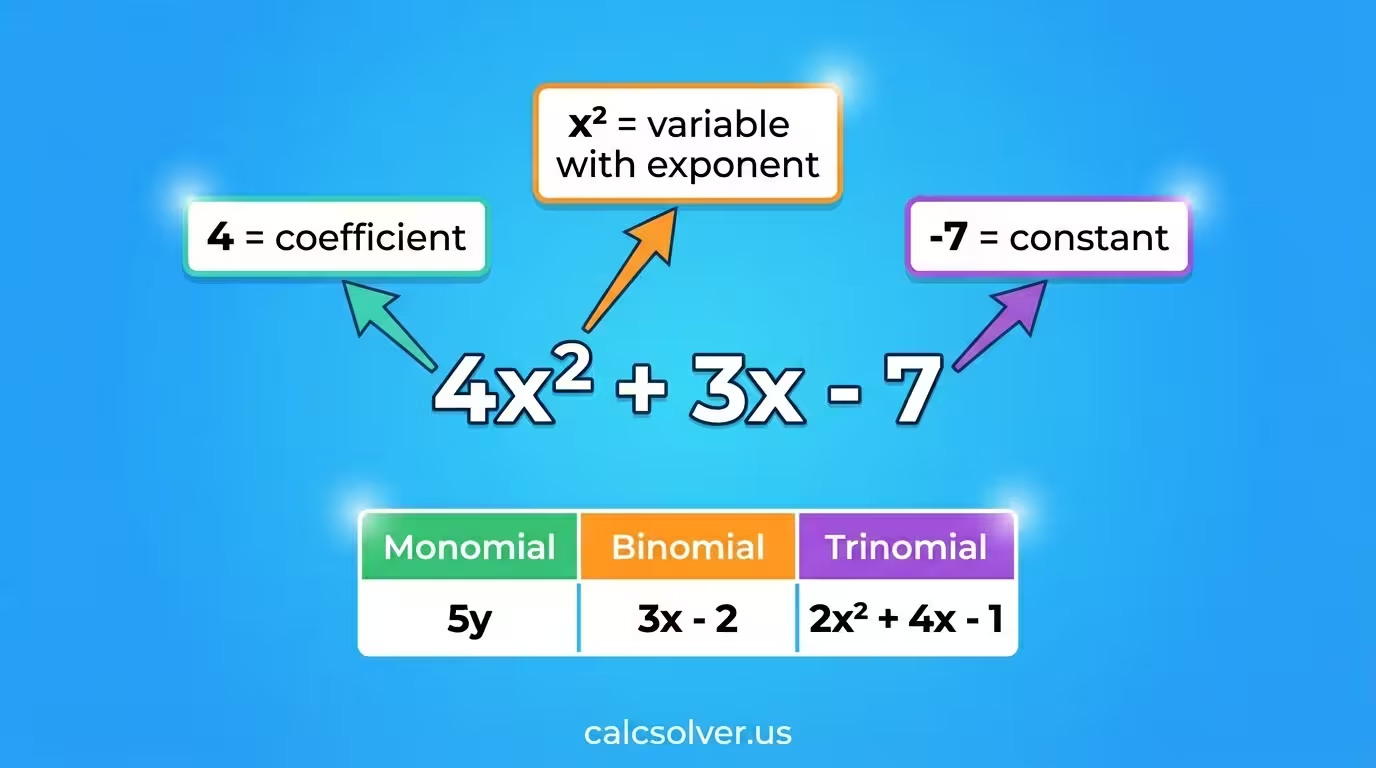
| Part | Definition | Example in 5x + 3 |
|---|---|---|
| Variable | A letter representing an unknown value | x |
| Constant | A fixed number with no variable attached | 3 |
| Coefficient | The number multiplied by a variable | 5 |
| Term | Each part separated by + or – | 5x and 3 are two terms |
One thing students often miss: if no number is written in front of a variable, the coefficient is 1. So x means 1x.
Types of Algebraic Expressions
Expressions are classified by how many terms they contain:
Monomial
One term only.
Examples: 5x, 7a², -9, 4xy
Binomial
Exactly two terms.
Examples: x + 5, 3a – 2, 6m² + 1
Trinomial
Exactly three terms.
Examples: x² + 3x + 2, 2m² – 4m + 1
Polynomial
One or more terms, typically used to describe expressions with four or more. Monomials, binomials, and trinomials are all technically polynomials, but in practice the word polynomial is used for longer expressions.
Examples: 4x³ + 2x² – x + 6, 7y⁴ – 3y² + 8
Numeric vs Variable Expressions
A numeric expression has only numbers and operations, like 10 + 5 or 15 ÷ 2. No variables. A variable expression includes at least one variable, like 4x + y or 5ab + 3. Most algebraic expressions are variable expressions.
How to Simplify Algebraic Expressions
Simplifying means combining like terms to write the expression in its shortest form.
Like terms share the same variable and the same exponent. You can only combine like terms with each other.
Example 1: 3x + 5x = 8x (same variable x, same exponent 1, just add coefficients)
Example 2: 4a + 7a – 2a (4 + 7 – 2)a = 9a
Example 3 (mixed terms): 5x² + 3x + 2x² – x Group like terms: (5x² + 2x²) + (3x – x) = 7x² + 2x
Terms with different variables or different exponents cannot be combined. 3x and 3x² are not like terms.
Operations on Algebraic Expressions
Addition
Add like terms together, leave unlike terms as they are.
(3x + 4) + (2x + 5) = 3x + 2x + 4 + 5 = 5x + 9
Subtraction
Distribute the negative sign first, then combine like terms.
(6x + 3) – (2x + 1) = 6x + 3 – 2x – 1 = 4x + 2
The most common mistake here is forgetting to flip the sign on every term inside the bracket after the minus sign.
Multiplication
Multiply coefficients together and add the exponents of matching variables.
(2x)(3x) = 6x²
For binomials, use the distributive property: (x + 2)(x + 3) = x² + 3x + 2x + 6 = x² + 5x + 6
Division
Cancel common factors between numerator and denominator.
8x² ÷ 2x = 4x
(12a³) ÷ (4a) = 3a²
Evaluating Algebraic Expressions
To evaluate means to substitute a specific number for the variable and calculate the result.
Example 1: Evaluate 3x + 2 when x = 4 = 3(4) + 2 = 12 + 2 = 14
Example 2: Evaluate 2a² – 3a + 1 when a = 3 = 2(9) – 3(3) + 1 = 18 – 9 + 1 = 10
Always substitute the value inside brackets to avoid sign errors, especially with negative numbers.
Example 3 (negative value): Evaluate x² + 5 when x = -2 = (-2)² + 5 = 4 + 5 = 9
Key Algebraic Identities for Expressions
These four identities apply directly to algebraic expressions and appear constantly in simplification and factoring problems. For the full set, see Basic Algebra Formulas with Examples.
| Identity | Expanded Form |
|---|---|
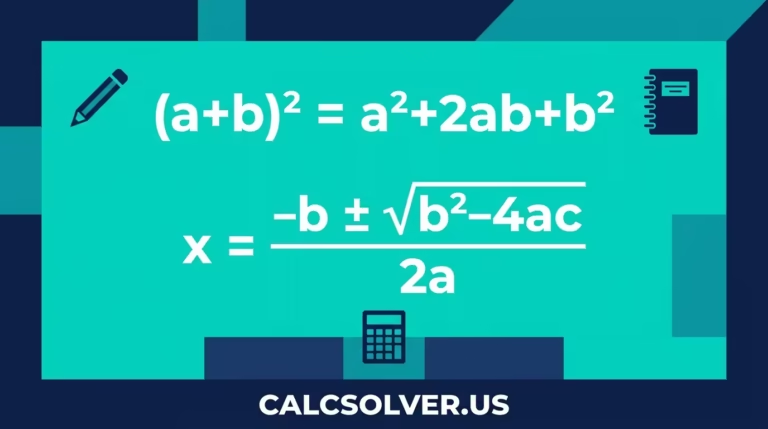
| (a + b)² | a² + 2ab + b² |
| (a – b)² | a² – 2ab + b² |
| (a + b)(a – b) | a² – b² |
| a² – b² | (a + b)(a – b) |
Example using identity 1: Expand (x + 3)² = x² + 2(x)(3) + 3² = x² + 6x + 9
Example using identity 3: Expand (y + 4)(y – 4) = y² – 16
Common Mistakes to Avoid
Combining unlike terms is the most frequent error. You cannot add 3x and 5x² because the exponents differ. Similarly, 2x and 2y cannot be combined because the variables differ.
Forgetting to distribute the negative sign in subtraction problems is the second most common issue. Always treat the minus sign as multiplying -1 through every term in the bracket.
Frequently Asked Questions
What is an algebraic expression?
An algebraic expression is a combination of numbers, variables, and operations. It does not have an equals sign. Examples include 4x + 7, 3a² – 2b, and 9.
What is the difference between an expression and an equation?
An expression has no equals sign. An equation has one and shows that two expressions are equal. 5x + 3 is an expression; 5x + 3 = 18 is an equation.
What are the four types of algebraic expressions?
The main types are monomial (one term), binomial (two terms), trinomial (three terms), and polynomial (multiple terms). Numeric and variable expressions are also recognized categories.
How do you simplify an algebraic expression?
Identify all like terms, then add or subtract their coefficients. Leave unlike terms unchanged. Write the result in standard form, typically with highest powers first.
What does evaluating an expression mean?
It means substituting a given number in place of the variable and then calculating the result using the order of operations.
Algebraic expressions are the building blocks of all algebra. Once you are comfortable identifying terms, combining like terms, and applying the four operations, more advanced topics like solving equations, factoring, and graphing become much easier to handle.