What Is Equivalent to 1/3? Complete Fraction List with Methods and Examples
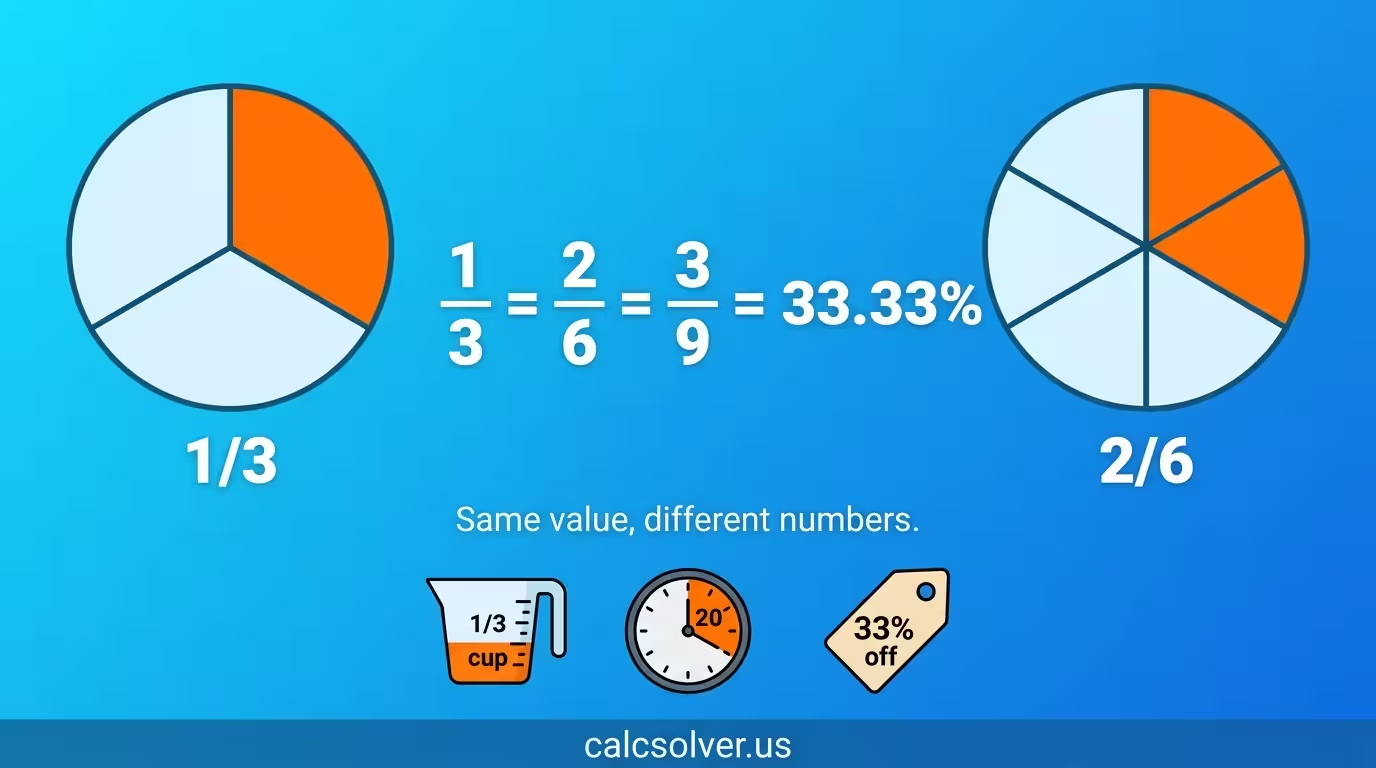
fractions equivalent to 1/3 include 2/6, 3/9, 4/12, 5/15, and infinitely more. They all represent the same value: approximately 0.333 or 33.33%. This guide covers how to find them, how to verify them, and where they show up in real calculations. You can check any fraction conversion instantly using the fraction and percent calculator tools on CalcSolver.
What Does 1/3 Mean?
The fraction 1/3 means one part out of three equal parts of a whole. The top number (1) is the numerator, which tells you how many parts you have. The bottom number (3) is the denominator, which tells you how many equal parts make the whole.
A simple example: a pizza cut into 3 equal slices. If you take one slice, you have 1/3 of the pizza.
What Makes Two Fractions Equivalent?
Two fractions are equivalent when they reduce to the same value. They look different because the numbers are larger or smaller, but the portion they represent is identical.
The rule: multiply or divide both numerator and denominator by the same non-zero number, and you get an equivalent fraction.
1/3 and 2/6 are equivalent because 2 divided by 2 = 1 and 6 divided by 2 = 3, giving back 1/3.
Full List of Equivalent Fractions for 1/3
| Multiplier | Numerator | Denominator | Equivalent Fraction | Decimal | Percent |
|---|---|---|---|---|---|
| x 2 | 1×2 = 2 | 3×2 = 6 | 2/6 | 0.333 | 33.33% |
| x 3 | 1×3 = 3 | 3×3 = 9 | 3/9 | 0.333 | 33.33% |
| x 4 | 1×4 = 4 | 3×4 = 12 | 4/12 | 0.333 | 33.33% |
| x 5 | 1×5 = 5 | 3×5 = 15 | 5/15 | 0.333 | 33.33% |
| x 6 | 1×6 = 6 | 3×6 = 18 | 6/18 | 0.333 | 33.33% |
| x 7 | 1×7 = 7 | 3×7 = 21 | 7/21 | 0.333 | 33.33% |
| x 8 | 1×8 = 8 | 3×8 = 24 | 8/24 | 0.333 | 33.33% |
| x 9 | 1×9 = 9 | 3×9 = 27 | 9/27 | 0.333 | 33.33% |
| x 10 | 1×10 = 10 | 3×10 = 30 | 10/30 | 0.333 | 33.33% |
Every fraction in this list divides back to 1/3 and converts to the same repeating decimal 0.333…
Method 1: Multiply to Generate Equivalent Fractions
This is the most straightforward approach.
Step 1: Pick any whole number, for example 5.
Step 2: Multiply both top and bottom by that number.
1 x 5 = 5 3 x 5 = 15
Result: 5/15 is equivalent to 1/3.
You can repeat this with any whole number. There is no upper limit, which is why 1/3 has infinitely many equivalent fractions.
Method 2: Simplify a Larger Fraction to Check Equivalence
Sometimes you have a fraction and need to check whether it reduces to 1/3. Divide both numerator and denominator by their greatest common factor (GCF).
Example: Is 9/27 equivalent to 1/3?
GCF of 9 and 27 is 9. 9 divided by 9 = 1 27 divided by 9 = 3
Result: 9/27 simplifies to 1/3. They are equivalent.
Example 2: Is 6/18 equivalent to 1/3?
GCF of 6 and 18 is 6. 6 divided by 6 = 1 18 divided by 6 = 3
Result: 6/18 = 1/3. Equivalent.
This method is especially useful when working with larger fractions like 25/75 or 100/300, which both reduce to 1/3.
Method 3: Cross Multiplication to Verify Equivalence
Cross multiplication is the fastest check when you cannot easily simplify.
Rule: Fractions a/b and c/d are equivalent if a x d = b x c.
Example 1: Is 4/12 equivalent to 1/3?
1 x 12 = 12 3 x 4 = 12
Both products are 12. Yes, 4/12 is equivalent to 1/3.
Example 2: Is 3/10 equivalent to 1/3?
1 x 10 = 10 3 x 3 = 9
Products differ (10 vs 9). No, 3/10 is not equivalent to 1/3.
| Fraction | Cross Multiply | Equivalent to 1/3? |
|---|---|---|
| 2/6 | 1×6=6, 3×2=6 | Yes |
| 3/9 | 1×9=9, 3×3=9 | Yes |
| 5/15 | 1×15=15, 3×5=15 | Yes |
| 3/10 | 1×10=10, 3×3=9 | No |
| 2/5 | 1×5=5, 3×2=6 | No |
Decimal and Percentage Value of 1/3
Unlike fractions with denominators that are factors of 10 (like 1/2 = 0.5 or 1/4 = 0.25), the fraction 1/3 produces a repeating decimal.
1 divided by 3 = 0.3333… (the 3 repeats forever)
As a percentage: 0.3333 x 100 = 33.33%
This is an important distinction. Fractions like 1/8 as a decimal give a clean terminating result (0.125), but 1/3 never terminates because 3 is not a factor of any power of 10.
Every equivalent fraction of 1/3, whether 2/6, 9/27, or 100/300, converts to the same 0.333… and 33.33%.
Simplifying Large Equivalent Fractions Back to 1/3
| Large Fraction | GCF | Simplifies to |
|---|---|---|
| 11/33 | 11 | 1/3 |
| 25/75 | 25 | 1/3 |
| 100/300 | 100 | 1/3 |
| 50/150 | 50 | 1/3 |
| 33/99 | 33 | 1/3 |
All of these reduce to 1/3. The larger the fraction, the bigger the GCF needed to simplify it.
How 1/3 Compares to Other Common Fractions
Knowing where 1/3 sits relative to nearby fractions helps with estimation and comparison:
| Fraction | Decimal | Percent |
|---|---|---|
| 1/4 | 0.250 | 25.0% |
| 1/3 | 0.333 | 33.33% |
| 3/8 | 0.375 | 37.5% |
| 2/5 | 0.400 | 40.0% |
| 1/2 | 0.500 | 50.0% |
1/3 is larger than 1/4 but smaller than 3/8. For a comparison with the full family of fifths including 3/5 as a decimal and percent, the pattern shows how each fraction maps to its decimal position.
Real-Life Uses of 1/3 Equivalent Fractions
Cooking and Recipes
A recipe calls for 1/3 cup of oil, but your measuring set only has a 1/6 cup measure. Since 1/3 = 2/6, you need two 1/6 cup scoops.
If you are tripling the recipe, you need 3/3 = 1 full cup.
Time Calculations
1/3 of one hour = 60 x (1/3) = 20 minutes. This comes up in scheduling, timed exams, and work session planning.
Discounts and Financial Splits
A 1/3 discount on a $90 item means you save $30. That is 33.33% off, leaving you paying $60.
Splitting a bill three ways equally means each person pays 1/3. If the bill is $75, each person pays $25.
Adding Fractions with Different Denominators
1/3 + 1/6: Convert 1/3 to 2/6, then add 2/6 + 1/6 = 3/6 = 1/2.
This is exactly where knowing equivalent fractions becomes necessary. Without converting 1/3 to 2/6, you cannot add these fractions directly. The same principle applies when working with expressions covered in algebraic expressions and operations.
Finding a Missing Number in an Equivalent Fraction
A common exam question: find x so that 1/3 = x/21.
Cross multiply: 1 x 21 = 3 x x 21 = 3x x = 7
So 7/21 is equivalent to 1/3.
Another type: find y so that 1/3 = 8/y.
1 x y = 3 x 8 y = 24
So 8/24 is equivalent to 1/3.
How 1/3 Compares to 3/4 Equivalents
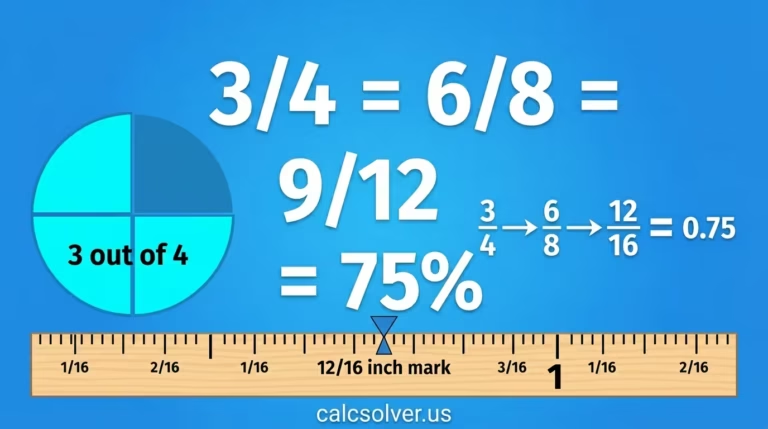
While 1/3 always gives 33.33%, fractions equivalent to 3/4 produce 0.75 and 75% at every step. The key difference is that 3/4 terminates cleanly while 1/3 repeats. Both have infinitely many equivalents, but the decimal behavior is completely different because of their denominators.
Frequently Asked Questions
What are 5 fractions equivalent to 1/3?
Five fractions equivalent to 1/3 are: 2/6, 3/9, 4/12, 5/15, and 6/18. Each is found by multiplying both numerator and denominator by 2, 3, 4, 5, and 6.
Is 2/6 the same as 1/3?
Yes. 2/6 simplifies to 1/3 when you divide both numbers by 2. Cross multiplication confirms it: 1 x 6 = 6 and 3 x 2 = 6.
What is 1/3 as a decimal?
1/3 as a decimal is 0.333… (the digit 3 repeats indefinitely). It is a non-terminating repeating decimal.
What is 1/3 as a percentage?
1/3 as a percentage is approximately 33.33%. Multiply 0.333 by 100 to get 33.33%.
How many equivalent fractions does 1/3 have?
Infinitely many. You can multiply both numerator and denominator by any whole number (2, 3, 4, 5…) and always get a new equivalent fraction.
How do you verify if a fraction is equivalent to 1/3?
Simplify it to lowest terms and check if you get 1/3. Or use cross multiplication: multiply 1 by the denominator and 3 by the numerator, then compare the products. If they match, the fraction is equivalent.
Is 3/9 equivalent to 1/3?
Yes. 3/9 divides down to 1/3 when you divide both by 3. It is one of the most commonly used equivalent forms of 1/3.
Equivalent fractions of 1/3 are everywhere in math, from adding fractions with unlike denominators to measuring ingredients and splitting costs. Once you know the multiply-or-divide rule and how to verify using cross multiplication, identifying and generating them becomes second nature.