What Is Equivalent to 7/9? Complete List, Verification Methods, and Real Examples
fractions equivalent to 7/9 include 14/18, 21/27, 28/36, 35/45, and infinitely more. Every one of them represents the same value: approximately 0.777… or 77.78%. This guide covers three methods to generate them, how to verify equivalence using cross multiplication, how to find a missing number in an equivalent fraction, and where 7/9 shows up in real calculations. For a full fraction-to-decimal converter, the math calculation tools on CalcSolver handle it instantly.
What Does 7/9 Mean?
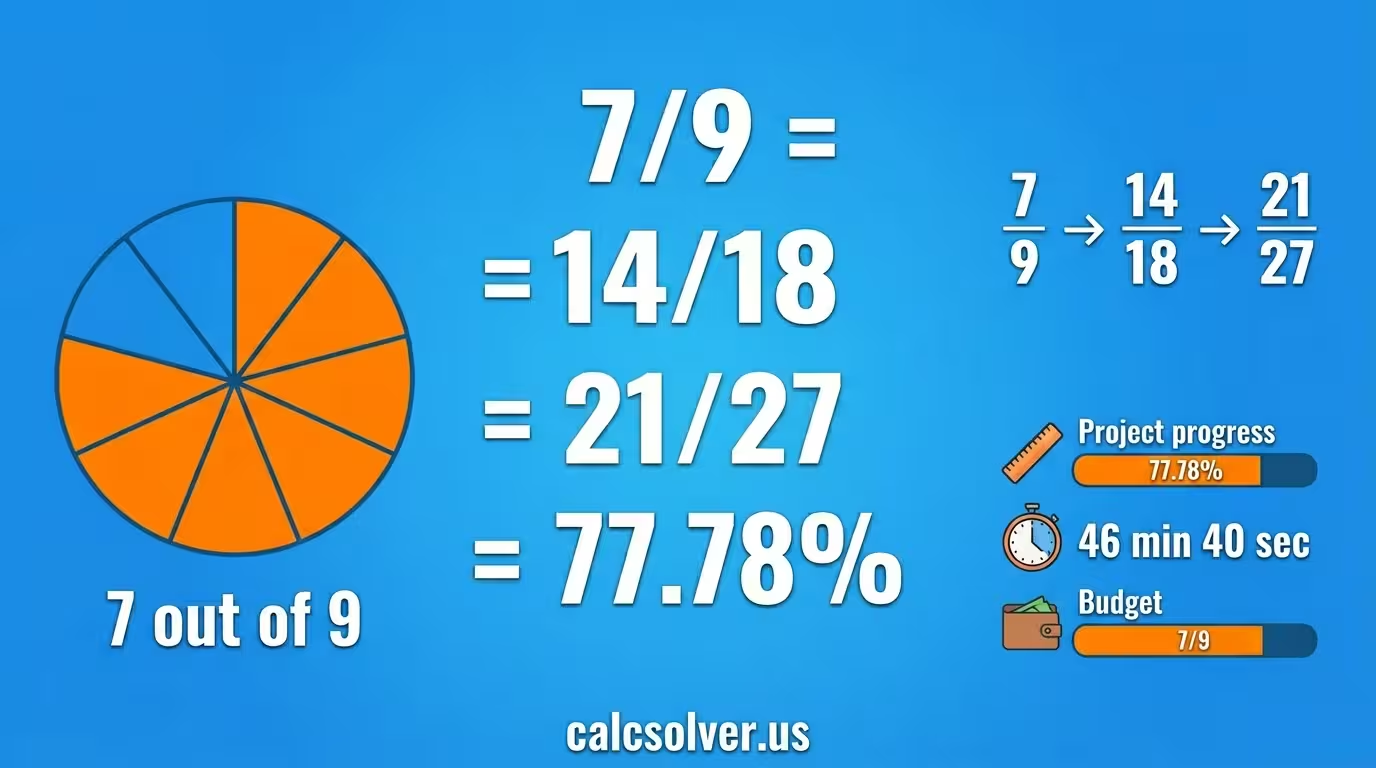
The fraction 7/9 represents seven parts taken out of nine equal parts of a whole. The top number (7) is the numerator, which tells you how many parts you have. The bottom number (9) is the denominator, which tells you how many parts make up the whole.
A practical example: a cake cut into 9 equal slices. If you eat 7 of them, you have eaten 7/9 of the cake, which is approximately 77.78% of it.
What Makes Two Fractions Equivalent?
Two fractions are equivalent when they reduce to the same value after simplification. The rule is straightforward: multiply or divide both the numerator and denominator by the same non-zero number, and the resulting fraction is equivalent to the original.
7/9 and 14/18 are equivalent because dividing both 14 and 18 by 2 gives back 7/9.
Complete List of Equivalent Fractions for 7/9
| Multiplier | Calculation | Equivalent Fraction | Decimal | Percent |
|---|---|---|---|---|
| x 2 | 7×2 / 9×2 | 14/18 | 0.777… | 77.78% |
| x 3 | 7×3 / 9×3 | 21/27 | 0.777… | 77.78% |
| x 4 | 7×4 / 9×4 | 28/36 | 0.777… | 77.78% |
| x 5 | 7×5 / 9×5 | 35/45 | 0.777… | 77.78% |
| x 6 | 7×6 / 9×6 | 42/54 | 0.777… | 77.78% |
| x 7 | 7×7 / 9×7 | 49/63 | 0.777… | 77.78% |
| x 8 | 7×8 / 9×8 | 56/72 | 0.777… | 77.78% |
| x 9 | 7×9 / 9×9 | 63/81 | 0.777… | 77.78% |
| x 10 | 7×10 / 9×10 | 70/90 | 0.777… | 77.78% |
Every fraction above simplifies back to 7/9. The decimal and percentage value stays the same no matter which equivalent form you use.
Method 1: Multiply to Generate Equivalent Fractions
This is the standard method and the one most used in classrooms.
Step 1: Choose any whole number, for example 6.
Step 2: Multiply both numerator and denominator by that number.
7 x 6 = 42 9 x 6 = 54
Result: 42/54 is equivalent to 7/9.
You can do this with any whole number indefinitely. There are infinitely many fractions equivalent to 7/9.
Method 2: Simplify a Larger Fraction Back to 7/9
When you have a larger fraction and need to verify whether it reduces to 7/9, divide both numbers by their greatest common factor (GCF).
Example: Is 63/81 equivalent to 7/9?
GCF of 63 and 81 is 9. 63 divided by 9 = 7 81 divided by 9 = 9
Result: 63/81 simplifies to 7/9. They are equivalent.
Example 2: Is 56/72 equivalent to 7/9?
GCF of 56 and 72 is 8. 56 divided by 8 = 7 72 divided by 8 = 9
Result: 56/72 = 7/9. Equivalent.
This method is useful when dealing with large fractions in measurements, test problems, or financial calculations where the numbers are not immediately obvious.
Method 3: Cross Multiplication to Verify Equivalence
Cross multiplication gives you a definitive yes or no answer without simplifying first.
Rule: Fractions a/b and c/d are equivalent if a x d = b x c.
Example 1: Is 21/27 equivalent to 7/9?
7 x 27 = 189 9 x 21 = 189
Both products match. Yes, 21/27 is equivalent to 7/9.
Example 2: Is 5/6 equivalent to 7/9?
7 x 6 = 42 9 x 5 = 45
Products differ (42 vs 45). No, 5/6 is not equivalent to 7/9.
| Fraction | Cross Multiply | Equivalent to 7/9? |
|---|---|---|
| 14/18 | 7×18=126, 9×14=126 | Yes |
| 21/27 | 7×27=189, 9×21=189 | Yes |
| 35/45 | 7×45=315, 9×35=315 | Yes |
| 5/6 | 7×6=42, 9×5=45 | No |
| 8/10 | 7×10=70, 9×8=72 | No |
Finding a Missing Number in an Equivalent Fraction
This type of question is common in school exams and competitive math tests.
Example 1: Find x so that 7/9 = x/45.
7 x 45 = 9 x x 315 = 9x x = 35
So 35/45 is equivalent to 7/9.
Example 2: Find y so that 7/9 = 49/y.
7 x y = 9 x 49 7y = 441 y = 63
So 49/63 is equivalent to 7/9. You can verify: both 49 and 63 divide by 7, giving back 7/9.
Decimal and Percentage Value of 7/9
7 divided by 9 = 0.7777… (the digit 7 repeats indefinitely)
0.777… x 100 = 77.77…% which rounds to 77.78%
This is a non-terminating repeating decimal, unlike fractions with denominators whose only prime factors are 2 and 5. Because 9 = 3 x 3, and 3 is not a factor of 10, the division never ends cleanly.
This is the same pattern as fractions equivalent to 1/3, where the decimal is 0.333… for the same reason: the denominator is a power of 3, so it can never divide evenly into a power of 10.
How 7/9 Compares to Other Common Fractions
| Fraction | Decimal | Percent |
|---|---|---|
| 1/2 | 0.500 | 50.00% |
| 3/5 | 0.600 | 60.00% |
| 2/3 | 0.667 | 66.67% |
| 3/4 | 0.750 | 75.00% |
| 7/9 | 0.778 | 77.78% |
| 4/5 | 0.800 | 80.00% |
| 7/8 | 0.875 | 87.50% |
7/9 sits between 3/4 and its equivalent fractions (75%) and 4/5 (80%), making it a fraction that is closer to the upper range of common values. This comparison is useful when estimating or checking whether an answer is reasonable.
Simplifying Large Equivalent Fractions of 7/9
| Large Fraction | GCF | Simplifies to |
|---|---|---|
| 77/99 | 11 | 7/9 |
| 84/108 | 12 | 7/9 |
| 140/180 | 20 | 7/9 |
| 700/900 | 100 | 7/9 |
| 350/450 | 50 | 7/9 |
All of these reduce to 7/9. Identifying the GCF quickly is the key skill that makes simplification fast.
Real-Life Uses of 7/9 Equivalent Fractions
Cooking and Recipes
A recipe calls for 7/9 cup of liquid. Your measuring set does not have a 9-part measure, but you can use 14/18 cup (measured in eighteenths) or approximate with 42/54 for larger batches.
Time Calculations
7/9 of one hour = 60 x (7/9) = 60 x 0.777… = 46.67 minutes, roughly 46 minutes and 40 seconds. This applies when scheduling fractional work sessions or reading timetables that use ninth-fractions.
Work and Project Completion
Completing 7/9 of a project means approximately 77.78% of the work is done. If a project has 27 total tasks and 21 are finished, that is 21/27, which is equivalent to 7/9.
Budget Allocation
Spending 7/9 of a budget means 77.78% is used. If the total budget is $900, spending $700 (which is 700/900 = 7/9) leaves $200 remaining.
Adding Fractions with Different Denominators
7/9 + 1/3: Convert 1/3 to 3/9, then add 7/9 + 3/9 = 10/9 = 1 and 1/9.
Without converting 1/3 to an equivalent fraction with denominator 9, you cannot add these directly. This is the same skill explained in more detail in the section on algebraic expressions and operations, where combining like terms works on the same principle of matching denominators or variables before operating.
Common Mistakes When Finding Equivalent Fractions of 7/9
Multiplying Only the Numerator or Only the Denominator
Both numbers must be multiplied by the same value. Multiplying just the top gives a completely different fraction.
Wrong: 7/9 becomes 14/9 (only top multiplied by 2) Right: 7/9 becomes 14/18 (both multiplied by 2)
Using Different Multipliers for Top and Bottom
If you multiply the numerator by 3 and the denominator by 4, you change the fraction’s value. The multiplier must be identical for both.
Rounding the Repeating Decimal
0.777… is not exactly 0.78. When precision matters, keep the repeating notation (0.7 repeating) or work with the fraction form directly.
Frequently Asked Questions
What are 5 fractions equivalent to 7/9?
Five fractions equivalent to 7/9 are: 14/18, 21/27, 28/36, 35/45, and 42/54. Each is found by multiplying both numerator and denominator by 2, 3, 4, 5, and 6 respectively.
What is 7/9 as a decimal?
7/9 as a decimal is 0.777… (the digit 7 repeats indefinitely). It is a non-terminating repeating decimal.
What is 7/9 as a percent?
7/9 as a percent is approximately 77.78%. Multiply 0.777… by 100 to get the percentage.
Is 14/18 equivalent to 7/9?
Yes. 14/18 simplifies to 7/9 when both numbers are divided by 2. Cross multiplication confirms: 7 x 18 = 126 and 9 x 14 = 126.
How many equivalent fractions does 7/9 have?
Infinitely many. You can multiply both numerator and denominator by any whole number to generate a new equivalent fraction.
How do you verify if a fraction is equivalent to 7/9?
Simplify the fraction to its lowest terms and check if you get 7/9. Alternatively, cross multiply: multiply 7 by the denominator of the test fraction and 9 by its numerator. If the products are equal, the fractions are equivalent.
Is 7/9 greater than 3/4?
Yes. 7/9 = 0.777… and 3/4 = 0.75. Since 0.777 is greater than 0.75, the fraction 7/9 is larger than 3/4.
What is 7/9 of 1 hour?
7/9 of 60 minutes = 60 x (7/9) = 46.67 minutes, or approximately 46 minutes and 40 seconds.
Equivalent fractions of 7/9 are useful any time you need to match denominators, scale a recipe, verify a test score, or estimate a budget allocation. The three methods covered here, multiplying, simplifying with GCF, and cross multiplication, give you reliable tools for any context, whether you are working by hand or checking your work.