What Is Equivalent to 3/4? Every Method Explained with a Full Fraction List
Quick answer: fractions equivalent to 3/4 include 6/8, 9/12, 12/16, 15/20, and infinitely more. They all represent the same value, which is 75% or 0.75 in decimal form. On CalcSolver, you can verify any fraction conversion instantly using the free calculator tools.
This guide covers how to find equivalent fractions of 3/4, three methods to generate them, how to verify them using cross multiplication, and where these fractions appear in real-world situations.
What Does the Fraction 3/4 Mean?
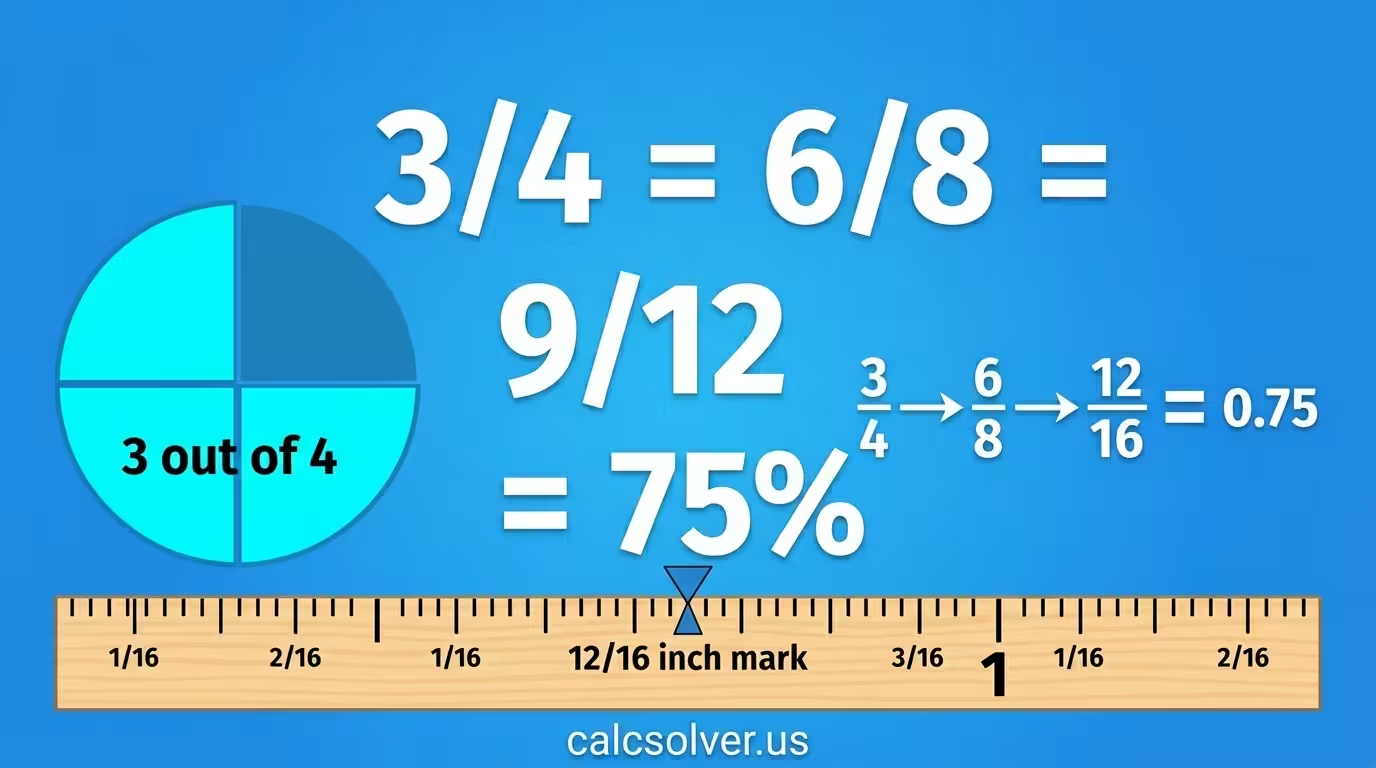
The fraction 3/4 means three parts taken out of four equal parts of a whole. The top number (3) is the numerator, which tells you how many parts you are working with. The bottom number (4) is the denominator, which tells you the total number of equal parts in the whole.
A practical example: a pizza is cut into 4 equal slices. If you eat 3 of them, you have eaten 3/4 of the pizza. In decimal form that is 0.75, and as a percentage it is 75%.
What Are Equivalent Fractions?
Equivalent fractions are fractions that look different but hold the same value. They represent the same portion of a whole, just expressed with different numbers.
The key rule: if you multiply or divide both the numerator and denominator by the same non-zero number, the resulting fraction is equivalent to the original.
3/4 and 6/8 are equivalent because 6/8 simplifies back to 3/4 when you divide both numbers by 2.
Complete List of Equivalent Fractions for 3/4
Multiply both numerator and denominator by the same number to generate equivalent fractions:
| Multiplier | Calculation | Equivalent Fraction | Decimal | Percent |
|---|---|---|---|---|
| x 2 | 3×2 / 4×2 | 6/8 | 0.75 | 75% |
| x 3 | 3×3 / 4×3 | 9/12 | 0.75 | 75% |
| x 4 | 3×4 / 4×4 | 12/16 | 0.75 | 75% |
| x 5 | 3×5 / 4×5 | 15/20 | 0.75 | 75% |
| x 6 | 3×6 / 4×6 | 18/24 | 0.75 | 75% |
| x 7 | 3×7 / 4×7 | 21/28 | 0.75 | 75% |
| x 8 | 3×8 / 4×8 | 24/32 | 0.75 | 75% |
| x 9 | 3×9 / 4×9 | 27/36 | 0.75 | 75% |
| x 10 | 3×10 / 4×10 | 30/40 | 0.75 | 75% |
Every fraction in this list equals exactly 0.75 or 75%. The decimal and percentage never change because the value stays the same.
Method 1: Multiply to Find Equivalent Fractions
This is the most common method and works in any direction.
Step 1: Choose any whole number to multiply by, for example 5.
Step 2: Multiply both numerator and denominator by that number.
3 x 5 = 15 4 x 5 = 20
Result: 15/20 is equivalent to 3/4.
You can do this with any whole number. There are infinitely many equivalent fractions for 3/4.
Method 2: Divide to Find the Simplest Form
Sometimes you start with a larger fraction and need to check whether it reduces to 3/4. This is called simplifying.
Example: Is 18/24 equivalent to 3/4?
Find the greatest common factor (GCF) of 18 and 24. The GCF is 6.
18 divided by 6 = 3 24 divided by 6 = 4
Result: 18/24 simplifies to 3/4. They are equivalent.
This is useful when comparing fractions in recipes, measurements, or academic problems where you need to identify the simplest form. Understanding this alongside how fractions relate to basic algebra formulas helps build a much stronger math foundation.
Method 3: Cross Multiplication to Verify Equivalence
Cross multiplication is the fastest way to check whether any two fractions are equivalent, without simplifying.
Rule: For fractions a/b and c/d, they are equivalent if a x d = b x c.
Example 1: Is 9/12 equivalent to 3/4?
3 x 12 = 36 4 x 9 = 36
Both products are 36. So yes, 9/12 is equivalent to 3/4.
Example 2: Is 7/10 equivalent to 3/4?
3 x 10 = 30 4 x 7 = 28
The products are different (30 vs 28), so 7/10 is not equivalent to 3/4.
| Fraction | Cross Multiply | Equal to 3/4? |
|---|---|---|
| 6/8 | 3×8=24, 4×6=24 | Yes |
| 9/12 | 3×12=36, 4×9=36 | Yes |
| 15/20 | 3×20=60, 4×15=60 | Yes |
| 7/10 | 3×10=30, 4×7=28 | No |
| 5/7 | 3×7=21, 4×5=20 | No |
How to Find a Missing Numerator or Denominator
A common exam question gives you one fraction and a partial second fraction, asking you to complete it.
Example: Find x so that x/20 = 3/4.
Set up the cross multiplication: 3 x 20 = 4 x x 60 = 4x x = 15
So 15/20 is equivalent to 3/4. You can verify: 15 and 20 both divide by 5, giving back 3/4.
Example 2: Find y so that 3/4 = 27/y.
3 x y = 4 x 27 3y = 108 y = 36
So 27/36 is equivalent to 3/4.
Decimal and Percentage Value of 3/4 and All Its Equivalents
Every fraction equivalent to 3/4 converts to the same decimal and percentage, no matter which form you use.
3 divided by 4 = 0.75
0.75 x 100 = 75%
Whether you are working with 6/8, 24/32, or 300/400, dividing the numerator by the denominator always gives 0.75. For a deeper look at how decimal and percent conversions work across different fractions, see 1/8 as a Decimal and Percent and 3/5 as a Decimal and Percent.
Why Equivalent Fractions Matter in Real Calculations
Cooking and Recipe Scaling
A recipe calls for 3/4 cup of sugar. Your measuring set only has a 1/8 cup measure. How many scoops do you need?
3/4 = 6/8, and since 1/8 fills one scoop, you need 6 scoops.
If you are doubling the recipe, you need 6/4 cups, which is the same as 1 and 1/2 cups. Equivalent fractions make this mental math possible without a calculator.
Adding Fractions with Different Denominators
Equivalent fractions are the tool you need to add fractions that have different denominators.
Example: 3/4 + 1/8
Convert 3/4 to 6/8 (multiply both by 2), then add: 6/8 + 1/8 = 7/8
Without finding the equivalent fraction first, you cannot add these directly.
Time Management
3/4 of one hour = 60 x 0.75 = 45 minutes.
6/8 of one hour = the same 45 minutes.
Both expressions mean the same thing. Knowing this allows you to convert quickly between different fractional representations of time.
Measurement and Construction
A cut piece of wood needs to be 3/4 of an inch thick. If you only have a ruler marked in sixteenths, you need to know that 3/4 = 12/16, so you measure to the 12th mark. Equivalent fractions bridge the gap between different measurement scales.
Academic Scores
A student scores 15 out of 20 on a test. Is this equivalent to 3/4?
15/20: divide both by 5 to get 3/4. Yes, 15/20 = 3/4 = 75%.
Simplifying Large Equivalent Fractions Back to 3/4
Some equivalent fractions use large numbers. Simplifying them back to 3/4 requires finding the greatest common factor.
| Large Fraction | GCF | Simplified Form |
|---|---|---|
| 75/100 | 25 | 3/4 |
| 150/200 | 50 | 3/4 |
| 300/400 | 100 | 3/4 |
| 33/44 | 11 | 3/4 |
| 27/36 | 9 | 3/4 |
All of these reduce to 3/4. The GCF is the largest number that divides both numerator and denominator evenly.
Common Mistakes When Finding Equivalent Fractions
Multiplying Only One Number
The most frequent error is multiplying just the numerator or just the denominator. Both must be multiplied by the same number, otherwise you change the value of the fraction.
Wrong: 3/4 becomes 6/4 (numerator only multiplied by 2) Right: 3/4 becomes 6/8 (both multiplied by 2)
Using Different Multipliers for Top and Bottom
If you multiply the numerator by 3 and the denominator by 5, you get a completely different fraction that is not equivalent to the original.
Confusing Equivalent With Equal Numerators or Denominators
Two fractions are not equivalent just because they share a numerator or denominator. 3/4 and 3/5 are not equivalent, even though both have 3 on top.
Frequently Asked Questions
What are 5 fractions equivalent to 3/4?
Five fractions equivalent to 3/4 are: 6/8, 9/12, 12/16, 15/20, and 18/24. Each is found by multiplying both numerator and denominator of 3/4 by 2, 3, 4, 5, and 6 respectively.
What is 3/4 as a decimal and percent?
3/4 as a decimal is 0.75 and as a percent is 75%. Divide 3 by 4 to get 0.75, then multiply by 100 to get 75%.
Is 6/8 equivalent to 3/4?
Yes. 6/8 simplifies to 3/4 when you divide both numbers by 2. Cross multiplication also confirms this: 3 x 8 = 24 and 4 x 6 = 24.
How many fractions are equivalent to 3/4?
There are infinitely many fractions equivalent to 3/4 because you can multiply both numerator and denominator by any whole number and get a new equivalent fraction.
Is 9/12 the same as 3/4?
Yes. 9/12 simplifies to 3/4 when you divide both by 3. Both represent 0.75 in decimal form and 75% as a percentage.
How do you check if a fraction is equivalent to 3/4?
Simplify the fraction to its lowest terms and see if you get 3/4. Alternatively, use cross multiplication: multiply 3 by the denominator of the test fraction and 4 by its numerator. If both products are equal, the fractions are equivalent.
What is the simplest form of an equivalent fraction to 3/4?
3/4 is already in its simplest form. The greatest common factor of 3 and 4 is 1, so it cannot be reduced any further.
Equivalent fractions of 3/4 appear in more places than most people realize: recipe measurements, test scores, time calculations, ruler markings, and financial allocations. The underlying math is always the same: multiply or divide both parts of the fraction by the same number, and the value stays at 0.75 or 75%.