Fraction Calculator: How to Add, Subtract, Multiply and Divide Fractions
Fractions are one of those topics that feel simple until you actually have to work with them. Adding 1/2 and 1/3 does not give you 2/5. Dividing by a fraction means flipping it and multiplying. These are the rules most people half-remember but keep getting wrong under pressure.
This guide covers all four fraction operations with clear steps, worked examples, and the exact mistakes to avoid. If you want to check your work instantly, the free fraction calculator at CalcSolver handles addition, subtraction, multiplication, division, and simplification with step-by-step results.
What Is a Fraction and What Are Its Parts
A fraction shows part of a whole. It has two parts:
- Numerator = the number on top (how many parts you have)
- Denominator = the number on bottom (how many equal parts the whole is divided into)
So 3/4 means you have 3 out of 4 equal parts.
There are three types that come up constantly:
| Type | Definition | Example |
|---|---|---|
| Proper fraction | Numerator smaller than denominator | 3/4, 2/7 |
| Improper fraction | Numerator equal to or bigger than denominator | 7/3, 9/4 |
| Mixed number | Whole number plus a proper fraction | 2 1/3, 4 3/5 |
Mixed numbers and improper fractions are just two ways to write the same value. 7/3 and 2 1/3 are the same number. Converting between them is something you will need to do regularly, especially before multiplying or dividing.
How to Add Fractions
Adding fractions is the operation where most mistakes happen. The rule is simple: you can only add fractions that have the same denominator.
Same Denominator (Easy Case)
If the denominators match, just add the numerators and keep the denominator.
3/8 + 2/8 = 5/8
That is it. Nothing else changes.
Different Denominators (Using LCM)
When denominators are different, you need to find the Least Common Multiple (LCM) of both denominators, convert both fractions to use that common denominator, then add.
Example: 1/3 + 1/4
Step 1: Find the LCM of 3 and 4. LCM = 12.
Step 2: Convert each fraction. 1/3 = 4/12 (multiply top and bottom by 4) 1/4 = 3/12 (multiply top and bottom by 3)
Step 3: Add the numerators. 4/12 + 3/12 = 7/12
Example: 2/5 + 3/4
LCM of 5 and 4 = 20 2/5 = 8/20 3/4 = 15/20 8/20 + 15/20 = 23/20 = 1 3/20
The answer is an improper fraction, so it converts to the mixed number 1 3/20.
How to Subtract Fractions
Subtraction follows the exact same process as addition. Get a common denominator first, then subtract the numerators.
Example: 5/6 – 1/4
LCM of 6 and 4 = 12 5/6 = 10/12 1/4 = 3/12 10/12 – 3/12 = 7/12
Example: 3 1/2 – 1 2/3 (mixed numbers)
Step 1: Convert to improper fractions. 3 1/2 = 7/2 1 2/3 = 5/3
Step 2: Find LCM of 2 and 3 = 6. 7/2 = 21/6 5/3 = 10/6
Step 3: Subtract. 21/6 – 10/6 = 11/6 = 1 5/6
Always convert mixed numbers to improper fractions before doing arithmetic. Trying to subtract the whole and fractional parts separately leads to errors, especially when you need to borrow.
How to Multiply Fractions
Multiplying fractions is actually the easiest operation. No common denominator needed. Just multiply straight across.
Rule: Multiply the numerators together. Multiply the denominators together. Simplify.
Example: 2/3 × 4/5
2 × 4 = 8 (new numerator) 3 × 5 = 15 (new denominator) Answer: 8/15
Example: 3/4 × 2/9
3 × 2 = 6 4 × 9 = 36 6/36 = 1/6 (simplified by dividing both by 6)
Multiplying mixed numbers:
Always convert to improper fractions first.
2 1/2 × 1 1/3 = 5/2 × 4/3 = 20/6 = 10/3 = 3 1/3
Quick Tip: Cross-Simplify Before Multiplying
Before multiplying, check if you can simplify diagonally. If numerator of one fraction shares a common factor with denominator of the other, cancel them first. This keeps numbers smaller.
3/4 × 8/9
3 and 9 share factor 3. 8 and 4 share factor 4. Cancel: (3/3) / (4/4) × (8/4) / (9/3) = 1/1 × 2/3 = 2/3
Much easier than multiplying 24/36 and then simplifying.
How to Divide Fractions
Division has one rule that never changes: flip the second fraction and multiply.
“Keep, Change, Flip”:
- Keep the first fraction as it is
- Change the division sign to multiplication
- Flip (find the reciprocal of) the second fraction
Example: 3/4 ÷ 2/5
Keep: 3/4 Change: × Flip: 5/2
3/4 × 5/2 = 15/8 = 1 7/8
Example: 5 ÷ 1/3
5 is the same as 5/1. 5/1 × 3/1 = 15
This is why dividing by a fraction gives a larger number. You are finding out how many one-thirds fit into 5. The answer is 15.
Example with mixed numbers: 2 1/4 ÷ 1 1/2
Convert first: 2 1/4 = 9/4 1 1/2 = 3/2
Now divide: 9/4 ÷ 3/2 = 9/4 × 2/3 = 18/12 = 3/2 = 1 1/2
Quick Reference: All Four Operations
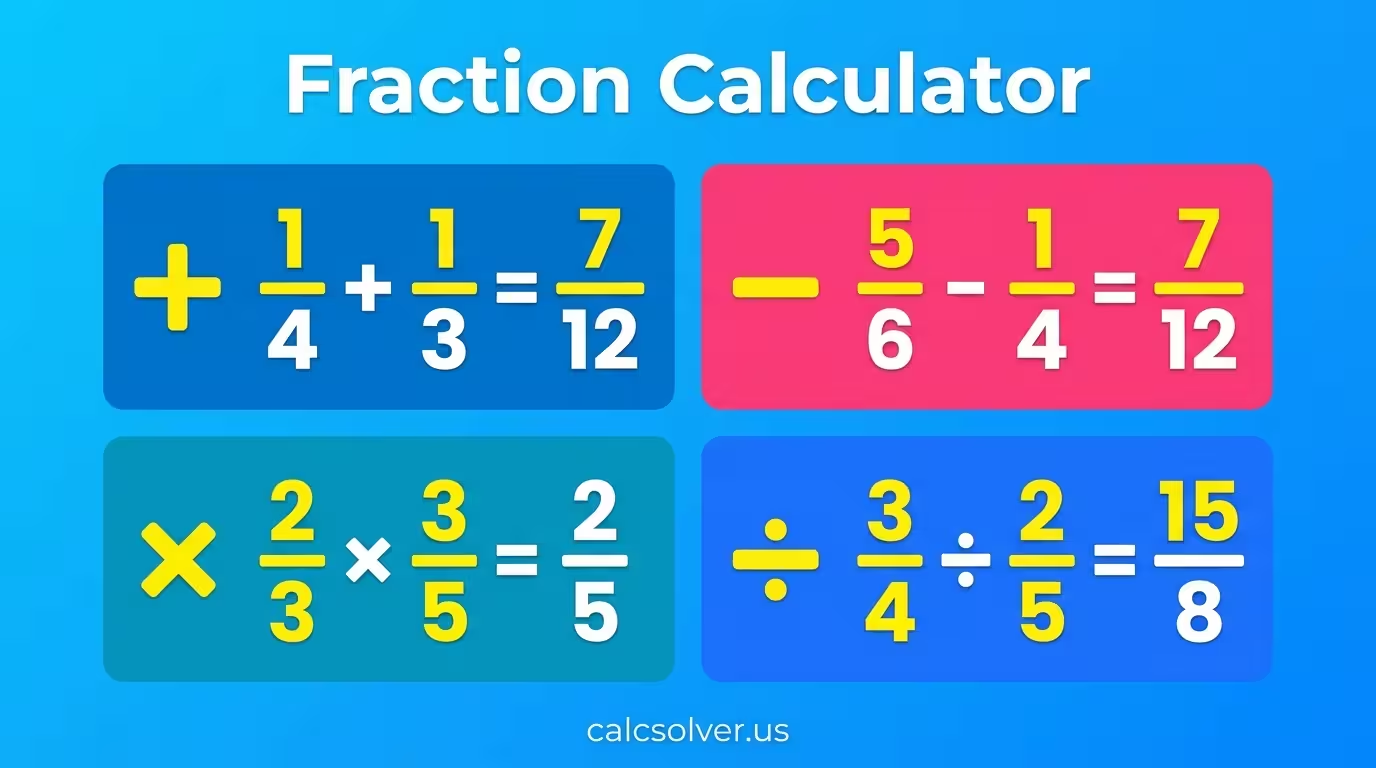
| Operation | Rule | Example |
|---|---|---|
| Addition | Find common denominator, add numerators | 1/4 + 1/3 = 3/12 + 4/12 = 7/12 |
| Subtraction | Find common denominator, subtract numerators | 3/4 – 1/3 = 9/12 – 4/12 = 5/12 |
| Multiplication | Multiply numerators, multiply denominators | 2/3 × 3/5 = 6/15 = 2/5 |
| Division | Keep, Change, Flip then multiply | 2/3 ÷ 4/5 = 2/3 × 5/4 = 10/12 = 5/6 |
How to Simplify Fractions
After any operation, always check if your answer can be simplified. A fraction is in its simplest form when the numerator and denominator share no common factors other than 1.
Method: Find the Greatest Common Divisor (GCD) of the numerator and denominator, then divide both by it.
Example: Simplify 18/24.
Factors of 18: 1, 2, 3, 6, 9, 18 Factors of 24: 1, 2, 3, 4, 6, 8, 12, 24 GCD = 6
18/6 = 3 24/6 = 4 Simplified: 3/4
Fractions in Real Life: Where You Actually Use This
People deal with fractions constantly, usually without thinking of them as math.
- Cooking: A recipe needs 2/3 cup of milk. You want to make half the recipe. 2/3 × 1/2 = 1/3 cup.
- Construction: A plank is 5 3/4 feet. You cut 2 1/2 feet off. Remaining = 5 3/4 – 2 1/2 = 3 1/4 feet.
- Time: A task takes 1 1/4 hours. You do it 3 times. Total = 1 1/4 × 3 = 15/4 = 3 3/4 hours.
- Exam scores: 38 correct out of 48 total. 38/48 simplifies to 19/24. Convert to see your percentage.
Common Fraction Mistakes and How to Fix Them
Adding denominators: 1/3 + 1/4 is not 2/7. Never add the denominators. Find the LCM and convert both fractions first.
Forgetting to convert mixed numbers: For multiplication and division, always turn 2 1/3 into 7/3 before doing anything else. Operating on mixed numbers directly causes wrong answers.
Not simplifying the final answer: 6/8 is technically correct but the expected answer is 3/4. Always simplify unless told otherwise.
Flipping the wrong fraction in division: Keep the first one, flip the second one. 3/4 ÷ 2/5 becomes 3/4 × 5/2. Not the other way.
If you want to double-check any of these, use the online fraction solver at CalcSolver which shows you each step, not just the final answer.
For context on how fractions connect to other math areas, our guide on how to solve percentage problems covers converting fractions to percentages in full detail. And if you are working with a scientific calculator, the guide on how to use a scientific calculator online explains how to handle fractions and other functions correctly.
For a broader understanding of which calculator tool handles what, basic vs scientific calculator breaks down exactly when each one is appropriate.
Frequently Asked Questions
Why can’t I just add the numerators and denominators together?
Because fractions represent parts of different-sized wholes. 1/3 and 1/4 are different sized slices. You cannot combine them until both are cut to the same size, which is what finding a common denominator does.
Do I always need to find the LCM for adding fractions?
You need a common denominator, but it does not have to be the LCM. You can multiply the two denominators together to get a common denominator, then simplify at the end. The LCM just keeps numbers smaller and saves a simplification step.
What is a reciprocal and why does it matter for division?
The reciprocal of a fraction is that fraction flipped upside down. The reciprocal of 3/4 is 4/3. Dividing by a number gives the same result as multiplying by its reciprocal. That is why dividing fractions works by flipping the second one.
How do I convert a mixed number to an improper fraction?
Multiply the whole number by the denominator, then add the numerator. That becomes the new numerator. Keep the same denominator. So 2 3/5 becomes (2 × 5 + 3)/5 = 13/5.
What is the GCD and how do I use it to simplify?
GCD stands for Greatest Common Divisor. It is the largest number that divides evenly into both the numerator and denominator. Divide both numbers by the GCD and you get the simplified fraction. For 12/18, the GCD is 6. Divide both by 6 to get 2/3.
Can fractions have negative numbers?
Yes. A negative sign can go in the numerator, the denominator, or in front of the whole fraction. They all mean the same thing: -1/2 = 1/(-2) = -(1/2). Operations with negative fractions follow the same positive/negative rules as integers.