How to Calculate Area and Volume for Basic Shapes (With Formulas and Examples)
Geometry trips students up not because the formulas are hard, but because there are too many of them and they all look similar until you actually sit down and work through each one. Area tells you how much flat space a shape covers. Volume tells you how much three-dimensional space a solid object takes up. Once you know which formula matches which shape and why, these calculations become fast and reliable.
This guide covers every basic 2D and 3D shape with the correct formula, a worked example, and the real situations where each one comes up.
When calculations involve squares, cube roots, or pi, the free online scientific calculator at CalcSolver handles all of it without switching tools. Pi is built in as a button, and powers are handled directly with x² and xʸ.
Area vs Volume: The Core Difference
Before jumping into formulas, understanding exactly what you are measuring prevents the most common errors.
Area is the amount of space inside a two-dimensional, flat shape. Think of it as the amount of paint needed to cover a wall, or the carpet needed to cover a floor. The answer is always in squared units: cm², m², ft².
Volume is the amount of space a three-dimensional solid object occupies. Think of it as the amount of water needed to fill a fish tank, or the amount of concrete needed to pour a column. The answer is always in cubic units: cm³, m³, ft³.
Surface area is a separate concept that applies to 3D shapes. It measures the total area of all outer faces combined, like the cardboard needed to make a box. It uses squared units just like regular area.
Never mix these up. A floor-tiling problem uses area (m²). A swimming pool fill problem uses volume (m³). Writing the wrong unit on an otherwise correct calculation loses marks in every exam.
Area of 2D Shapes
Square
A square has four equal sides. The area is simply the side length multiplied by itself.
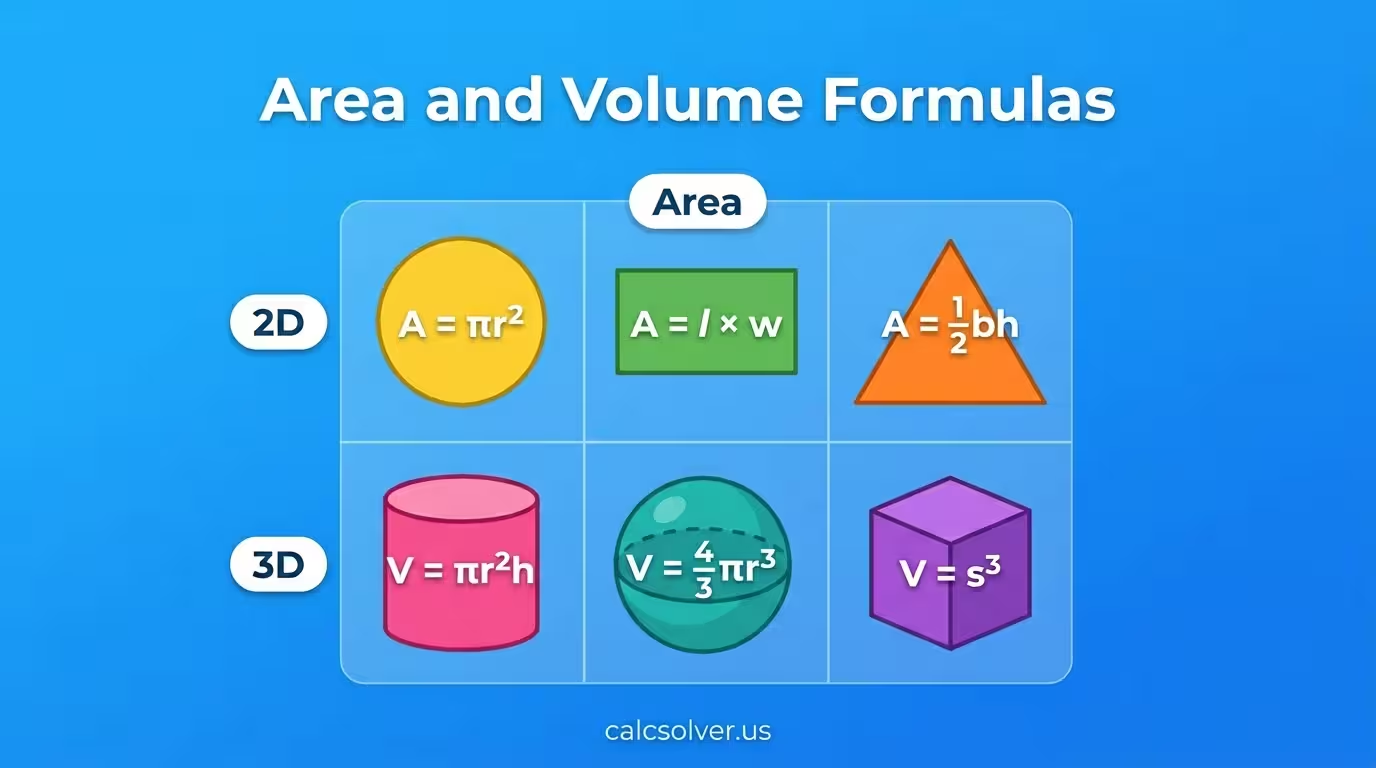
Formula: A = s²
Example: A square tile has a side of 4 cm. A = 4² = 16 cm²
Rectangle
A rectangle has two pairs of equal sides. Multiply length by width.
Formula: A = l × w
Example: A room is 6 m long and 4 m wide. A = 6 × 4 = 24 m²
This is the calculation you need when buying carpet, tiles, or paint for a flat surface.
Triangle
A triangle’s area is always half of its base multiplied by its perpendicular height. The height must be the vertical distance between the base and the opposite point, not a slanted side.
Formula: A = ½ × b × h
Example: A triangle has a base of 10 cm and a height of 6 cm. A = ½ × 10 × 6 = 30 cm²
A triangle is exactly half of a parallelogram with the same base and height. That is where the ½ comes from, not just a number someone chose.
Circle
The area of a circle depends on its radius, which is the distance from the center to the edge.
Formula: A = πr²
Example: A circular garden has a radius of 5 m. A = π × 5² = π × 25 = 78.54 m²
Remember: radius is half the diameter. If someone gives you a diameter of 12, the radius is 6.
For linear equations and formula rearrangement including circle problems, our guide on how to solve linear equations step by step shows you how to isolate a variable when the formula is rearranged to find the radius from a known area.
Parallelogram
A parallelogram looks like a slanted rectangle. Its area is base multiplied by the perpendicular height, not the slanted side.
Formula: A = b × h
Example: A parallelogram has a base of 8 cm and a perpendicular height of 5 cm. A = 8 × 5 = 40 cm²
Trapezoid
A trapezoid has two parallel sides of different lengths. The formula averages those two sides and multiplies by the height between them.
Formula: A = ½ × (a + b) × h
Where a and b are the two parallel sides and h is the perpendicular height between them.
Example: A trapezoid has parallel sides of 6 cm and 10 cm, with a height of 4 cm. A = ½ × (6 + 10) × 4 = ½ × 16 × 4 = 32 cm²
Complete Reference: Area Formulas for 2D Shapes
| Shape | Formula | Variables |
|---|---|---|
| Square | A = s² | s = side length |
| Rectangle | A = l × w | l = length, w = width |
| Triangle | A = ½ × b × h | b = base, h = perpendicular height |
| Circle | A = πr² | r = radius |
| Parallelogram | A = b × h | b = base, h = perpendicular height |
| Trapezoid | A = ½ × (a + b) × h | a, b = parallel sides, h = height |
Volume of 3D Shapes
Cube
A cube has six equal square faces. Volume is the side length cubed.
Formula: V = s³
Example: A cube-shaped box has a side of 3 cm. V = 3³ = 27 cm³
Cuboid (Rectangular Prism)
The shape of most boxes, rooms, and storage containers. Multiply all three dimensions.
Formula: V = l × w × h
Example: A fish tank is 50 cm long, 25 cm wide, and 30 cm deep. V = 50 × 25 × 30 = 37,500 cm³
Converting to litres: 37,500 cm³ = 37.5 litres. This is how you calculate how much water a tank holds.
Cylinder
A cylinder is a circle stretched to a height. Its volume is the area of the circular base multiplied by the height.
Formula: V = πr²h
Example: A cylindrical water tank has a radius of 2 m and a height of 5 m. V = π × 2² × 5 = π × 4 × 5 = 62.83 m³
Soda cans, pipes, and columns are all cylinders. This formula is used constantly in engineering and construction.
Sphere
A sphere is a perfectly round 3D shape where every point on the surface is the same distance from the center.
Formula: V = (4/3) × π × r³
Example: A sphere has a radius of 3 cm. V = (4/3) × π × 3³ = (4/3) × π × 27 = 4 × π × 9 = 113.1 cm³
Footballs, globes, water drops. Anywhere you need to know the space inside a round object.
The fraction in this formula, (4/3), makes students hesitate. If fractions in calculations slow you down, our guide on how to add and multiply fractions correctly covers the arithmetic needed to handle them confidently.
Cone
A cone has a circular base that tapers to a point. Its volume is exactly one-third of a cylinder with the same base and height.
Formula: V = (1/3) × π × r² × h
Example: An ice cream cone has a radius of 3 cm and a height of 12 cm. V = (1/3) × π × 9 × 12 = (1/3) × π × 108 = 113.1 cm³
Square Pyramid
A pyramid with a square base. Volume is one-third of the base area multiplied by the height.
Formula: V = (1/3) × l² × h
Example: A pyramid has a square base of 6 cm per side and a height of 9 cm. V = (1/3) × 36 × 9 = (1/3) × 324 = 108 cm³
Complete Reference: Volume Formulas for 3D Shapes
| Shape | Formula | Variables |
|---|---|---|
| Cube | V = s³ | s = side length |
| Cuboid | V = l × w × h | l = length, w = width, h = height |
| Cylinder | V = πr²h | r = radius, h = height |
| Sphere | V = (4/3)πr³ | r = radius |
| Cone | V = (1/3)πr²h | r = base radius, h = height |
| Square Pyramid | V = (1/3)l²h | l = base side, h = height |
Surface Area: The Outside of a 3D Shape
Surface area tells you the total area of every face of a 3D object added together. It uses squared units, not cubic. You need it when calculating how much material covers the outside of a shape: packaging, paint for a sculpture, sheet metal for a tank.
| Shape | Surface Area Formula |
|---|---|
| Cube | SA = 6s² |
| Cuboid | SA = 2(lw + lh + wh) |
| Cylinder | SA = 2πr² + 2πrh |
| Sphere | SA = 4πr² |
Example: Surface area of a cylinder with radius 4 cm and height 10 cm.
SA = 2π(4²) + 2π(4)(10) SA = 2π(16) + 2π(40) SA = 32π + 80π SA = 112π = 351.86 cm²
Real-Life Geometry Calculations
These are not textbook exercises. These are situations where knowing these formulas saves time and money.
Painting a room: You need the total area of all four walls. Each wall is a rectangle. Add all four together. Subtract the area of any doors and windows before buying paint.
Buying flooring: Measure the length and width of the room in meters. Multiply to get the area in m². Add 10% extra for cuts and waste.
Filling a swimming pool: A rectangular pool 8 m long, 4 m wide, and 1.5 m deep holds 8 × 4 × 1.5 = 48 m³ of water. At 1000 litres per m³, that is 48,000 litres.
Wrapping a cylindrical gift: You need the surface area of the cylinder to know how much wrapping paper to cut.
Packing boxes: A shipping company pays by volume. A cuboid box 60 cm × 40 cm × 30 cm occupies 72,000 cm³ or 0.072 m³.
Understanding how percentages connect to geometry comes up in every real-life scenario above. A 15% contingency on flooring area, a 20% discount on paint price. Our guide on solving percentage problems covers those calculations in full.
Most Common Mistakes in Area and Volume
Using diameter instead of radius The area and volume formulas for circles, cylinders, spheres, and cones all require the radius, not the diameter. If given a diameter, always divide by 2 before substituting into any formula.
Forgetting to square the radius before multiplying by pi A = πr² means π × (r × r). Not π × r then squared. The exponent applies to r alone.
Using slanted height instead of perpendicular height For triangles and parallelograms, the height must be perpendicular (a right angle) to the base. The slanted side of a triangle is not the height. Using it gives a larger, wrong answer.
Mixing up area and volume units Area is always squared (cm², m²). Volume is always cubed (cm³, m³). If you calculate volume but write cm², the answer is technically wrong regardless of the number.
Forgetting the (1/3) in cone and pyramid volume Both formulas include (1/3). It is there because a cone fills exactly one-third of the cylinder with the same base and height. Skipping it triples your answer.
Frequently Asked Questions
What is the difference between area and volume?
Area measures the flat space inside a two-dimensional shape and is expressed in squared units like cm² or m². Volume measures the space a three-dimensional solid object occupies and is expressed in cubic units like cm³ or m³. A rectangle has area. A rectangular box has volume.
How do you find the area of a circle?
Use the formula A = πr² where r is the radius of the circle. Square the radius first, then multiply by π (3.14159). If you have the diameter, divide it by 2 to get the radius before using the formula.
What is the formula for the volume of a cylinder?
The volume of a cylinder is V = πr²h, where r is the radius of the circular base and h is the height. First calculate the area of the circular base using πr², then multiply by the height.
Why does the cone volume formula have 1/3 in it?
A cone with a given base radius and height has exactly one-third the volume of a cylinder with the same base radius and height. The (1/3) is a mathematical constant that reflects this geometric relationship. Same logic applies to pyramids compared to prisms.
How do you calculate the surface area of a 3D shape?
Find the area of every individual face and add them all together. For regular shapes like cubes and cylinders there are standard formulas. A cube has 6 equal square faces so its surface area is 6s². A cylinder has two circular ends plus one rectangular side that wraps around, giving SA = 2πr² + 2πrh.
What units should I use for area and volume answers?
Area answers must always be in squared units matching your measurements. If you measured in centimeters, the area is in cm². If you measured in meters, the area is in m². Volume answers must always be in cubed units: cm³, m³, or ft³. Never write a volume answer in squared units or an area answer in cubed units.