How to Solve Percentage Problems Without a Formula
Most people freeze when they see a percentage problem. Either they reach for a calculator or they try to remember a formula they half-learned in school. The truth is, once you understand what a percentage actually means, most problems become straightforward without needing any formula at all.
This guide walks through every type of percentage problem you will encounter, from basic to reverse, with real examples and the mental shortcuts that actually work.
Before anything else, if you want to verify your answers quickly, the free percentage calculator at CalcSolver covers all types including reverse percentages, increase, decrease, and finding what percent one number is of another.
What a Percentage Actually Means
A percentage is just a fraction out of 100. That is it. The word itself comes from the Latin “per centum,” meaning per hundred. So when someone says 35%, they literally mean 35 out of every 100.
Once you see it that way:
- 50% = half
- 25% = one quarter
- 75% = three quarters
- 10% = one tenth
- 1% = one hundredth
Every percentage calculation comes down to this one core idea: Percentage = (Part / Whole) × 100. Everything else is a variation of this.
The 4 Types of Percentage Problems
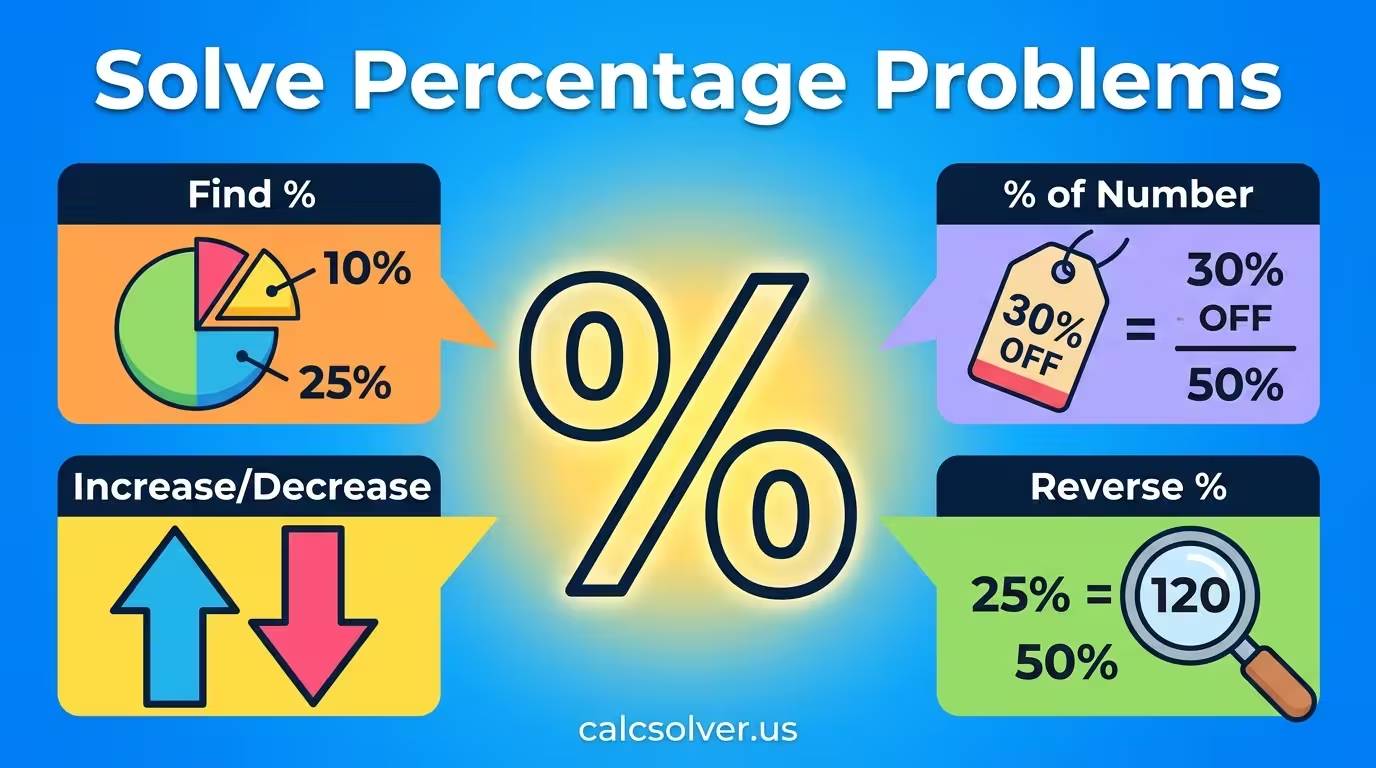
There are four main types of percentage questions you will face in school, in exams, or in everyday life. Each needs a slightly different approach.
| Problem Type | What It Asks | Example |
|---|---|---|
| Type 1: Find a percentage of a number | What is X% of Y? | What is 20% of 150? |
| Type 2: Find what percent | X is what % of Y? | 30 is what % of 120? |
| Type 3: Percentage increase or decrease | New value after X% change? | 200 increased by 15% |
| Type 4: Reverse percentage | Find original before X% change | Price is $80 after 20% off |
Type 1: Finding a Percentage of a Number
This is the most common one. “What is 30% of 250?”
Method: Convert the percentage to a decimal and multiply.
30% = 0.30 0.30 × 250 = 75
So 30% of 250 is 75.
The 10% shortcut: Finding 10% of any number is instant. Just move the decimal point one place to the left.
- 10% of 430 = 43
- 10% of 1,800 = 180
- 10% of 75 = 7.5
From there, you can build any percentage mentally:
| Percentage | Method | Example (of 200) |
|---|---|---|
| 10% | Move decimal left one place | 20 |
| 5% | Halve the 10% value | 10 |
| 20% | Double the 10% value | 40 |
| 25% | Divide by 4 | 50 |
| 50% | Divide by 2 | 100 |
| 15% | Add 10% + 5% | 30 |
| 30% | Triple the 10% value | 60 |
| 1% | Move decimal left two places | 2 |
Example with a tricky number: What is 17.5% of 80?
Break it down: 10% of 80 = 8, then 5% of 80 = 4, then 2.5% of 80 = 2. Add them: 8 + 4 + 2 = 14. Done.
Type 2: Finding What Percent One Number Is of Another
“30 is what percent of 120?”
Method: Divide the part by the whole, then multiply by 100.
30 / 120 = 0.25 0.25 × 100 = 25%
So 30 is 25% of 120.
Another example: “A student scored 42 out of 60. What is the percentage?”
42 / 60 = 0.70 0.70 × 100 = 70%
This type shows up constantly in exam results, sports stats, and survey data.
Type 3: Percentage Increase and Decrease
Percentage increase formula: New Value = Original × (1 + Percentage/100)
Percentage decrease formula: New Value = Original × (1 – Percentage/100)
Example of increase: A salary of $2,000 gets a 12% raise. New salary?
$2,000 × 1.12 = $2,240
Example of decrease: A product costs $350 and goes on 25% sale. Sale price?
$350 × 0.75 = $262.50
Finding the percentage change between two numbers:
Formula: (New – Old) / Old × 100
A stock was $50 and is now $62. What is the percentage increase?
(62 – 50) / 50 × 100 = 12 / 50 × 100 = 24% increase
This one appears in finance problems, science experiments, and any comparison of before-and-after values.
Type 4: Reverse Percentage (Finding the Original Value)
This is the one that trips most people up. You are given the final value after a percentage change has already happened, and you need to find the original.
After an increase: Original = Final / (1 + Percentage/100)
After a decrease: Original = Final / (1 – Percentage/100)
Example: A jacket now costs $85 after a 15% discount. What was the original price?
The current price represents 85% of the original (since 15% was removed). Original = 85 / 0.85 = $100
Common mistake: Most people calculate 15% of $85 and add it back. That gives $97.75, which is wrong. The percentage was applied to the original price, not the sale price. Always divide the final value by the remaining percentage as a decimal.
Another example: A number increases by 20% to become 144. Find the original.
Original = 144 / 1.20 = 120
Check: 120 × 1.20 = 144. Correct.
Real-Life Percentage Problems and How to Solve Them
Shopping Discount
A $120 coat is 30% off. What do you pay?
Pay = $120 × 0.70 = $84
Or think of it as: 10% of $120 = $12, so 30% = $36 off. $120 – $36 = $84.
Restaurant Tip
Bill is $67. You want to leave an 18% tip. How much?
10% of $67 = $6.70 8% = 5% + 3% = $3.35 + $2.01 = $5.36
Total tip ≈ $6.70 + $5.36 = $12.06. Round to $12.
Exam Score
You answered 38 out of 50 correctly. What percentage is that?
38 / 50 × 100 = 76%
Tax Calculation
A product costs $200 before 8% sales tax. Total cost?
Tax = $200 × 0.08 = $16 Total = $200 + $16 = $216
Or: $200 × 1.08 = $216 directly.
Salary Increase
You earn $3,500 and get a 7% raise. New salary?
$3,500 × 1.07 = $3,745
Common Mistakes in Percentage Problems
Mistake 1: Applying the wrong percentage to the wrong base
In reverse percentage problems, people calculate a percentage of the final value instead of the original. Always identify which number is the base before calculating.
Mistake 2: Treating percentage increase and decrease as symmetrical
Increasing by 20% and then decreasing by 20% does not give you the original number. Start with 100. Increase by 20% gives 120. Decrease 120 by 20% gives 96, not 100. The base changes between the two calculations.
Mistake 3: Converting percentages incorrectly
15% as a decimal is 0.15, not 1.5 and not 15. Moving the decimal two places to the left always converts percentage to decimal.
Mistake 4: Using the sale price in reverse calculations
If a price drops 25% to $60, the original is $60 / 0.75 = $80. Not $60 + 25% of $60 = $75. That is a different calculation on a different base.
When You Need a Calculator
Mental tricks work well for round numbers and common percentages. When numbers get messy, like 17.3% of 462.8 or a multi-step reverse percentage, a calculator gives you precision without the risk of compounding rounding errors.
The online calc solver at CalcSolver handles every percentage type in one place. Pair it with the understanding from this guide and you will both know what you are calculating and get the right answer every time.
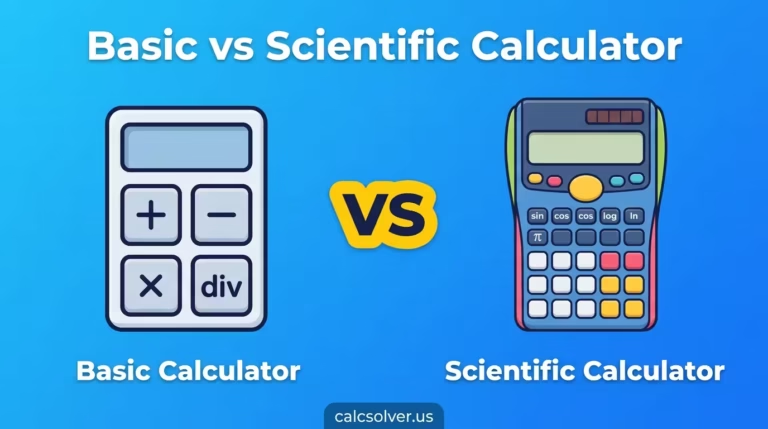
For anyone who found the calculation methods here useful, understanding the difference in tools also helps. Our guide on basic calculator vs scientific calculator explains which tool handles which types of problems. And if you are using a scientific calculator for your percentage work, the step-by-step guide to using a scientific calculator online covers all the keys you need.
Frequently Asked Questions
How do I calculate percentage without a formula?
Use the 10% shortcut as your base. Find 10% by moving the decimal one place left, then build any percentage from there by doubling, halving, or adding. For example, 35% = 10% + 10% + 10% + 5%. No formula needed, just simple addition of easy parts.
What is the easiest way to find a percentage of a number mentally?
Convert the percentage to a simpler fraction where possible. 25% = divide by 4. 50% = divide by 2. 20% = divide by 5. For less round numbers, find 10% first then scale up or down with addition and halving.
How do you solve reverse percentage problems?
Identify what percentage the current value represents of the original. If a price dropped 20%, the current price is 80% of the original. Divide the current value by 0.80 to get the original. The key is dividing, not adding the percentage back on.
What is the formula for percentage increase?
Percentage increase = (New Value – Original Value) / Original Value × 100. If a price goes from $50 to $60, the increase is (60 – 50) / 50 × 100 = 20%.
Why is increasing by 10% then decreasing by 10% not zero?
Because each percentage is applied to a different base. Increasing $100 by 10% gives $110. Decreasing $110 by 10% removes $11, giving $99, not $100. The base for the decrease is larger than the original, so the decrease removes more in absolute terms.
How is percentage used in real life?
Percentages appear in discounts and sale prices, tax calculations, interest rates, exam scores, salary increases, statistics and survey results, nutrition labels, and population growth figures. It is one of the most practical math skills for everyday use.