How to Solve Linear Equations Step by Step (With Examples and Word Problems)
Linear equations are the foundation of algebra. Everything from budgeting your monthly expenses to calculating speed and distance runs on the same logic a linear equation uses. Yet most students struggle not because the concept is hard, but because nobody showed them a clear, repeatable process to follow.
This guide breaks every type of linear equation down with proper worked examples, so you can solve them correctly every time, not just when the numbers are easy.
If you need to verify your answers as you practice, the free algebra calculator at CalcSolver handles linear equations directly in your browser.
What Is a Linear Equation
A linear equation is an equation where the highest power of any variable is exactly 1. No x², no square roots of x, just x to the power of one.
The standard forms are:
| Type | Form | Example |
|---|---|---|
| One variable | Ax + B = 0 | 3x + 6 = 0 |
| One variable (general) | Ax + B = C | 2x + 5 = 11 |
| Two variables | Ax + By = C | 2x + 3y = 12 |
The word “linear” comes from the fact that these equations, when graphed, always produce a straight line. That is why they are called linear.
Solving a linear equation means finding the value of the variable that makes both sides of the equation equal. When you find x = 3, it means substituting 3 in place of x makes the left side equal to the right side.
The Core Rule That Never Changes
Whatever you do to one side of an equation, you must do the same to the other side.
Think of an equation as a perfectly balanced scale. Add 5 to the left side without adding 5 to the right and the scale tips. Every operation, whether addition, subtraction, multiplication, or division, must happen on both sides simultaneously.
This one rule governs every linear equation you will ever solve.
How to Solve a One-Variable Linear Equation
The goal is always the same: isolate the variable on one side by undoing everything around it.
Simple Linear Equations
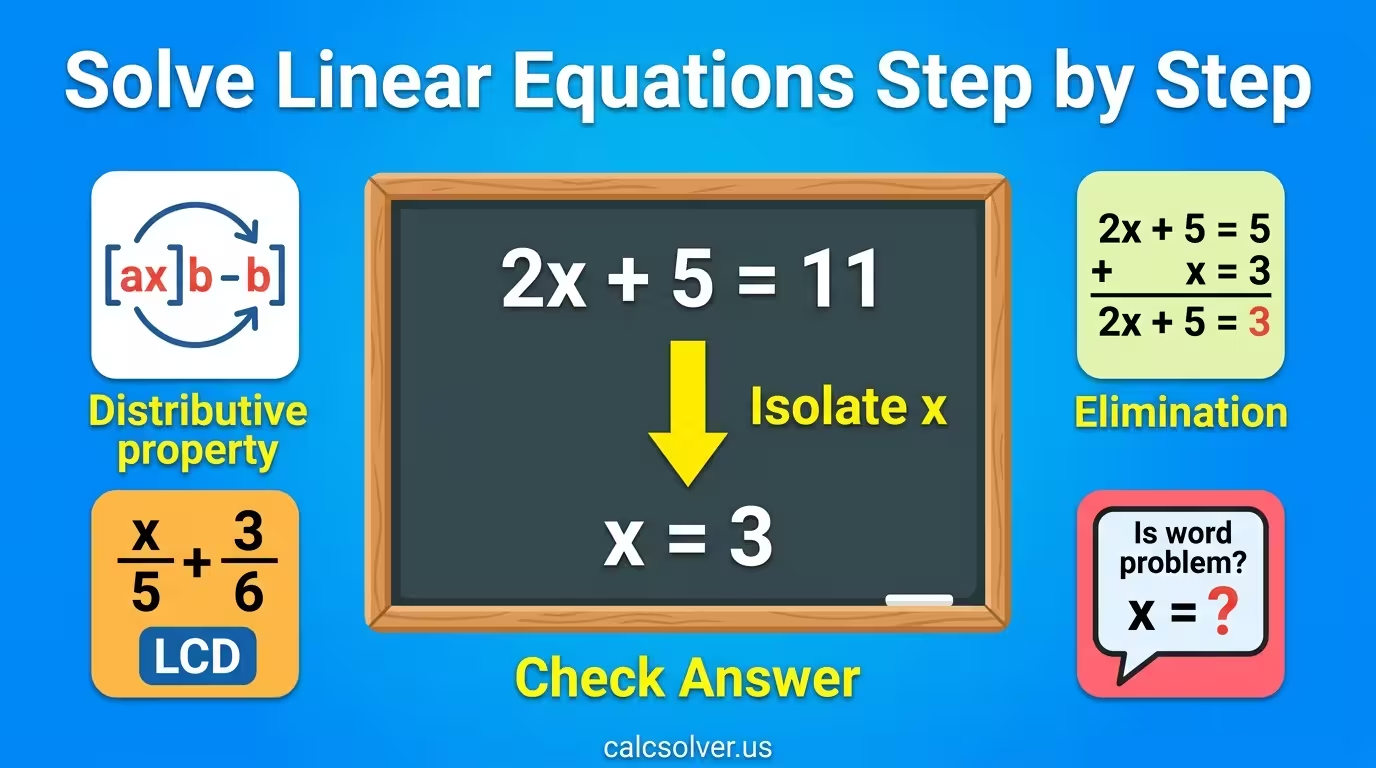
Example 1: Solve 2x + 5 = 11
Step 1: Subtract 5 from both sides. 2x + 5 – 5 = 11 – 5 2x = 6
Step 2: Divide both sides by 2. 2x / 2 = 6 / 2 x = 3
Check: 2(3) + 5 = 6 + 5 = 11. Correct.
Example 2: Solve 4x – 7 = 13
Step 1: Add 7 to both sides. 4x = 20
Step 2: Divide both sides by 4. x = 5
Check: 4(5) – 7 = 20 – 7 = 13. Correct.
Linear Equations With Variables on Both Sides
When variables appear on both sides, move them all to one side first.
Example: Solve 5x – 3 = 2x + 9
Step 1: Subtract 2x from both sides to move variables left. 5x – 2x – 3 = 9 3x – 3 = 9
Step 2: Add 3 to both sides. 3x = 12
Step 3: Divide both sides by 3. x = 4
Check: 5(4) – 3 = 17 and 2(4) + 9 = 17. Both sides match.
Linear Equations With Parentheses (Distributive Property)
When you see brackets, expand them first using the distributive property before doing anything else.
Example: Solve 3(2x – 4) = 18
Step 1: Expand the bracket. 6x – 12 = 18
Step 2: Add 12 to both sides. 6x = 30
Step 3: Divide both sides by 6. x = 5
Check: 3(2×5 – 4) = 3(10 – 4) = 3(6) = 18. Correct.
Example with brackets on both sides: Solve 2(3x – 1) = 4(x + 3)
Step 1: Expand both sides. 6x – 2 = 4x + 12
Step 2: Subtract 4x from both sides. 2x – 2 = 12
Step 3: Add 2 to both sides. 2x = 14
Step 4: Divide by 2. x = 7
Check: 2(3×7 – 1) = 2(20) = 40 and 4(7 + 3) = 4(10) = 40. Correct.
How to Solve Linear Equations With Fractions
Fractions in linear equations make students panic, but there is a clean trick: multiply the entire equation by the LCD (Least Common Denominator) first to clear all fractions before solving.
Example: Solve x/3 + x/4 = 7
Step 1: LCD of 3 and 4 is 12. Multiply every term by 12. 12(x/3) + 12(x/4) = 12(7) 4x + 3x = 84
Step 2: Combine like terms. 7x = 84
Step 3: Divide by 7. x = 12
Check: 12/3 + 12/4 = 4 + 3 = 7. Correct.
Our guide on how to add and divide fractions correctly covers the LCD method in full detail if you need a refresher before tackling equations like this.
Example: Solve (2x – 1)/3 = 5
Step 1: Multiply both sides by 3. 2x – 1 = 15
Step 2: Add 1 to both sides. 2x = 16
Step 3: Divide by 2. x = 8
Quick Reference: Steps for Every Type
| Equation Type | First Step | Example |
|---|---|---|
| Simple (Ax + B = C) | Move constants first | 3x + 5 = 11 → 3x = 6 |
| Variables both sides | Move variables to one side | 5x – 3 = 2x + 9 → 3x = 12 |
| With parentheses | Distribute first | 3(2x – 4) = 18 → 6x – 12 = 18 |
| With fractions | Multiply by LCD first | x/3 + x/4 = 7 → 7x = 84 |
| Word problem | Translate to equation first | “5 more than twice x is 17” → 2x + 5 = 17 |
How to Solve Systems of Two-Variable Linear Equations
When you have two unknowns, you need two equations. The two main methods are substitution and elimination.
Substitution Method
Use this when one equation already has one variable isolated.
Example: Solve x + y = 6 and x = y + 2
Since the second equation gives x directly, substitute it into the first.
(y + 2) + y = 6 2y + 2 = 6 2y = 4 y = 2
Now substitute y = 2 back: x = 2 + 2 = 4.
Solution: x = 4, y = 2.
Check: 4 + 2 = 6. Correct.
Elimination Method
Use this when neither variable is isolated. Add or subtract the equations to cancel one variable.
Example: Solve 2x + y = 11 and x + y = 7
Subtract the second equation from the first. (2x + y) – (x + y) = 11 – 7 x = 4
Substitute x = 4 into x + y = 7. 4 + y = 7 y = 3
Solution: x = 4, y = 3.
Check: 2(4) + 3 = 11. Correct. 4 + 3 = 7. Correct.
Solving Linear Equation Word Problems
Word problems feel harder because you have to build the equation yourself before solving. There is a clear process for this.
Steps:
- Read the problem and identify the unknown. Assign it a variable, usually x.
- Translate the word problem into an algebraic equation.
- Solve the equation.
- Check the answer against the original problem to make sure it makes sense.
Example 1: Age problem John is 5 years older than Sarah. Together their ages add up to 25. How old is each?
Let Sarah’s age = x John’s age = x + 5 Equation: x + (x + 5) = 25 2x + 5 = 25 2x = 20 x = 10
Sarah is 10. John is 15. Check: 10 + 15 = 25. Correct.
Example 2: Distance and speed A bus travels at 50 km/h. How many hours to cover 175 km?
Distance = Speed × Time 175 = 50t t = 175 / 50 t = 3.5 hours
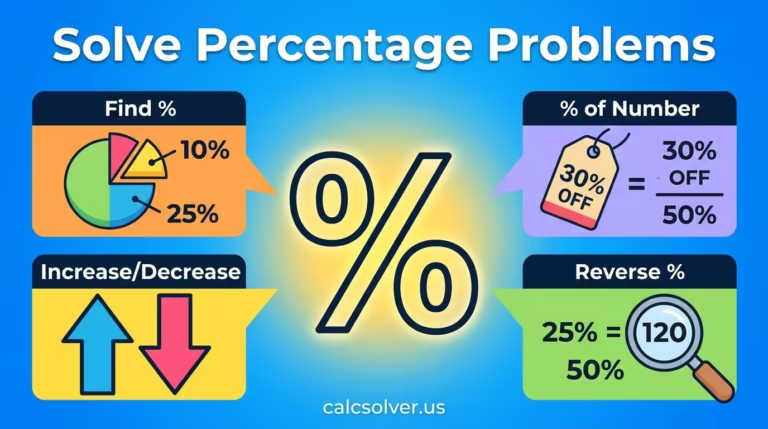
The relationship between calculating percentages and linear equations overlaps often in problems involving discounts and interest. The process of isolating one variable connects directly to the percentage increase and reverse percentage techniques covered in our guide to solving percentage problems without a formula.
Example 3: Cost and quantity Pens cost $2 each and notebooks cost $5 each. You buy 8 items and spend $22. How many of each?
Let pens = x, notebooks = y x + y = 8 2x + 5y = 22
From the first equation: x = 8 – y Substitute: 2(8 – y) + 5y = 22 16 – 2y + 5y = 22 3y = 6 y = 2
So y = 2 notebooks and x = 6 pens.
Checking Your Answer (Never Skip This)
Every time you solve a linear equation, substitute your answer back into the original equation and verify both sides are equal. Students who skip this step consistently lose marks on exams for avoidable errors.
If your check does not work, the error is usually one of these:
- Sign error when moving a term (forgetting that x becomes -x when moved across the equals sign)
- Not applying an operation to every term on the side (especially with brackets and fractions)
- Dividing by the wrong coefficient
The check takes ten seconds. Do it every time.
When You Need a Calculator for Linear Equations
Simple equations are fast by hand. But once you have multi-step systems with decimal coefficients, or equations with multiple fractions, doing it manually compounds rounding errors. That is where a proper calculator saves time and accuracy.
The online math solver at CalcSolver handles linear equations and algebraic expressions with clean step-by-step output. And if you are also using a scientific calculator alongside this, our guide on basic calculator vs scientific calculator explains which tool is designed for which type of problem.
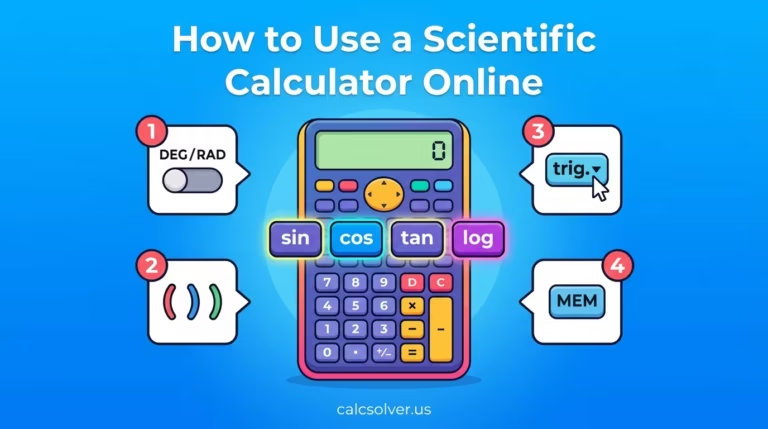
For students who work with both algebra and trigonometry in the same session, the breakdown of every function available to you is in our step-by-step guide to using a scientific calculator online.
Common Mistakes in Linear Equations
Sign errors when moving terms across the equals sign If 3x – 5 = 10, adding 5 to both sides gives 3x = 15, not 3x = 5. Moving a term means reversing its sign.
Not distributing properly 3(2x – 4) is not 6x – 4. You must multiply the 3 by both the 2x and the 4 to get 6x – 12.
Only multiplying one term when clearing fractions When you multiply by the LCD, every single term in the equation gets multiplied, including the constant on the other side. Missing one term gives a completely wrong answer.
Forgetting to check the answer This is the only sure way to catch arithmetic slips before they cost you marks.
Frequently Asked Questions
What is a linear equation in simple terms?
A linear equation is any equation where the variable has a power of exactly 1 and the graph forms a straight line. Examples include 2x + 3 = 9 or 3x + 4y = 16. Solving it means finding the value of the unknown that makes both sides equal.
How do you solve a linear equation step by step?
First, simplify both sides by expanding brackets and combining like terms. Second, move all variable terms to one side and constants to the other. Third, divide or multiply to make the variable’s coefficient equal to 1. Finally, substitute your answer back into the original equation to verify.
How do you solve linear equations with fractions?
Multiply every term in the equation by the Least Common Denominator (LCD) of all fractions. This clears all fractions from the equation and leaves you with a standard linear equation to solve normally.
What is the difference between one-variable and two-variable linear equations?
A one-variable equation like 3x + 5 = 11 has one unknown and one solution. A two-variable equation like 2x + 3y = 12 has two unknowns and requires a second equation to find a unique solution. Two equations with two unknowns form a system that can be solved by substitution or elimination.
How do you solve word problems with linear equations?
Read the problem, identify the unknown, assign it a variable, translate the words into an algebraic equation, solve it, then check that the answer makes sense in the context of the original problem.
Why do you need to do the same operation on both sides?
An equation is a statement that two sides are equal. Performing the same operation on both sides keeps that equality intact. Changing one side without changing the other destroys the balance and makes the equation false.